

What Is a Blastocyst? IVF Embryo Development & Blastocyst Transfer Guide
What is a blastocyst? This is one of the most common questions couples ask during IVF treatment, especially when the doctor talks about embryo development, embryo grading, blastocyst culture, or blastocyst transfer. In simple words, a blastocyst is an embryo that has developed for a few days after fertilization and has reached a more advanced stage before transfer into the uterus.
For couples going through IVF, every small word can feel big: eggs, sperm, fertilization, embryos, day 3, day 5, blastocyst, implantation, transfer. It can sound technical at first. But when explained properly, the concept becomes much easier to understand.
At Ova Fertility and Women Care, blastocyst culture and transfer is part of advanced IVF care. The clinic explains that blastocyst culture and transfer is a part of IVF treatment and may help improve pregnancy chances, while also allowing single embryo transfer and reducing the risk of multiple pregnancy.
This blog will explain what a blastocyst is, how it develops during IVF, why doctors may wait until the blastocyst stage, what blastocyst transfer means, and how it may help in better embryo selection.
What Is a Blastocyst?
A blastocyst is an embryo that has grown to an advanced stage after fertilization. During IVF, eggs are collected from the ovaries and fertilized with sperm in the laboratory. Once fertilization happens, the embryo starts dividing and developing.
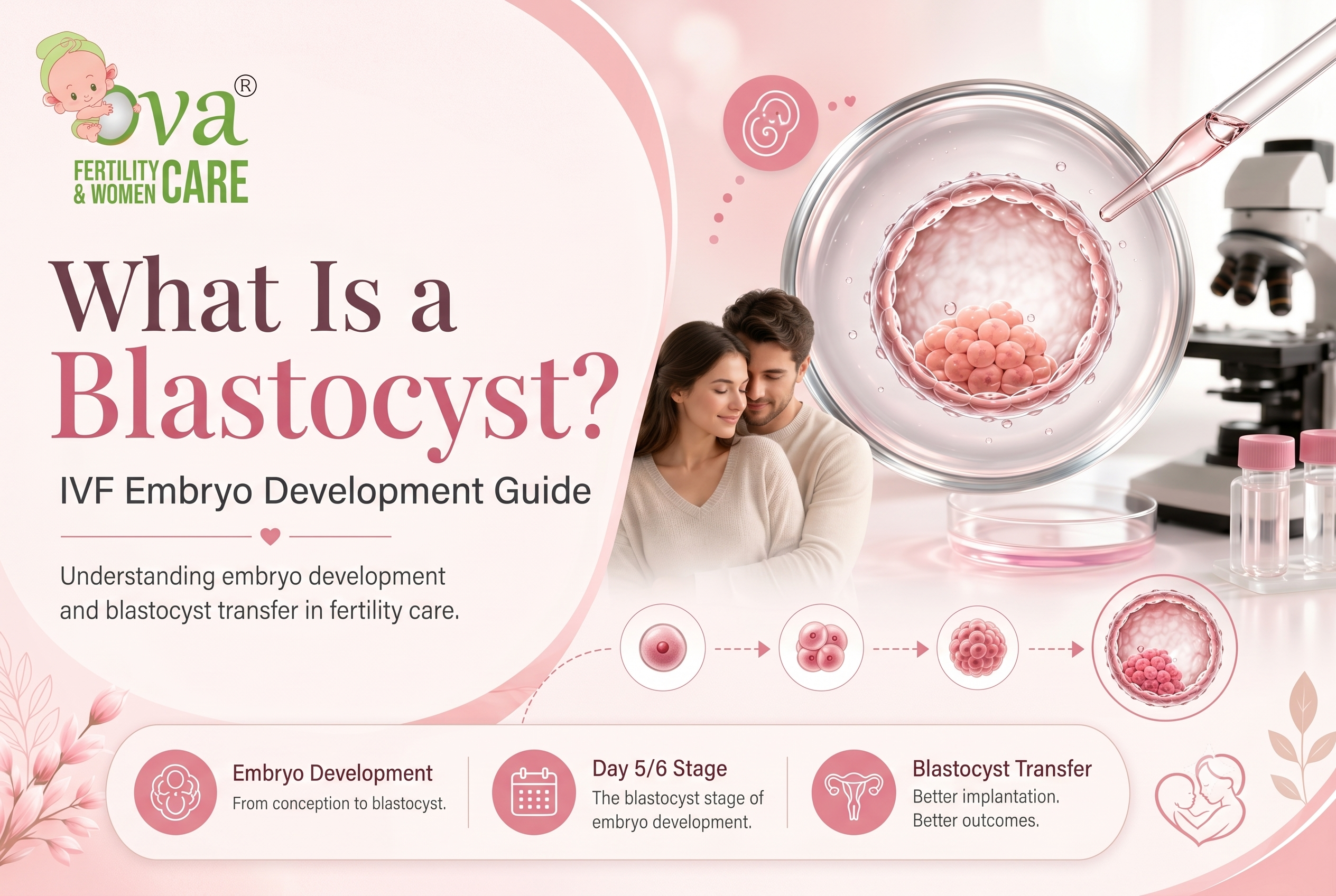
In the first few days, the embryo is made up of a small number of cells. As it continues to grow, it becomes more organized. Around the fifth or sixth day after fertilization, many embryos reach the blastocyst stage.
A blastocyst has two important parts:
- Inner cell mass: This part can develop into the baby.
- Trophectoderm cells: These cells later help form the placenta.
- Fluid-filled cavity: This cavity forms inside the embryo as it matures.
When someone asks, “What is a blastocyst?” the easiest way to explain it is this: a blastocyst is an embryo that has developed for around five to six days in the IVF laboratory and has reached a stage closer to when an embryo naturally moves into the uterus for implantation.
Featured Snippet Answer: What Is a Blastocyst?
A blastocyst is an embryo that has developed for around five to six days after fertilization. In IVF treatment, embryos may be cultured in the laboratory until they reach the blastocyst stage before transfer. Blastocyst transfer can help fertility specialists select embryos that have shown stronger development potential.
How Does an Embryo Become a Blastocyst?
Embryo development is a gradual process. It does not become a blastocyst immediately after fertilization. It goes through different stages first.
Day 0: Egg Retrieval and Fertilization
In IVF, fully developed eggs are retrieved from the ovaries as part of the treatment process.These eggs are then fertilized with sperm in the laboratory. Fertilization may happen through conventional IVF or ICSI, depending on the couple’s fertility condition.
At Ova Fertility and Women Care, IVF and ICSI are part of fertility care services offered to couples, along with related advanced treatments such as blastocyst culture, laser assisted hatching, embryo freezing, and Pre-implantation Genetic Testing.
Day 1: Fertilization Check
The embryology team checks whether fertilization has happened properly. Not every egg fertilizes, and not every fertilized egg continues to grow. This is a normal part of IVF.
Day 2 to Day 3: Embryo Development at the Cleavage Stage
At this stage, the embryo divides into multiple cells. Many embryos are assessed on day 2 or day 3. Earlier, embryo transfers were commonly done at this stage. In some cases, day 3 transfer may still be advised depending on the patient’s condition and embryo development.
Day 4: Morula Stage
By day 4, the embryo may become a compact ball of cells. This stage is called the morula stage. The cells start becoming more connected and organized.
Day 5 to Day 6: Blastocyst Stage
By day 5 or day 6, a healthy developing embryo may become a blastocyst. This means it has formed a fluid-filled cavity and has started differentiating into parts that later support fetal and placental development.
This is the stage where blastocyst transfer may be planned if the embryo has developed well.
Why Is the Blastocyst Stage Important in IVF?
The blastocyst stage is important because it shows that the embryo has continued to develop beyond the early cell division stage. Not all embryos reach this stage. So, when an embryo becomes a blastocyst, it gives the fertility team more information about its development potential.
Blastocyst culture allows embryologists to observe which embryos continue growing in the lab for a longer period. This can support better embryo selection before transfer.
In practical terms, blastocyst stage helps with:
- Better observation of embryo development
- Selection of embryos that continue growing well
- More natural timing of embryo transfer
- Possibility of single embryo transfer in suitable cases
- Reduced chance of transferring multiple embryos unnecessarily
- Better planning for embryo freezing if needed
Ova Fertility and Women Care mentions that blastocyst transfer can allow single embryo transfer and reduce the risk of multiple pregnancy.
What Is Blastocyst Culture?
Blastocyst culture means growing embryos in the IVF laboratory until they reach the blastocyst stage. Instead of transferring embryos earlier, the fertility team may wait for a few more days to see which embryos continue developing.
This process needs proper laboratory conditions, skilled embryologists, and careful embryo monitoring.
Blastocyst culture is not just “waiting for five days.” It involves creating a supportive lab environment where embryos can continue development outside the body for a short period. The embryology team observes their growth, quality, and progress.
At Ova Fertility and Women Care, blastocyst culture and transfer is listed as a fertility treatment service, along with IVF, IUI, ICSI, male infertility care, Pre-implantation Genetic Testing, laser assisted hatching, and embryo freezing.
What Is Blastocyst Transfer?
Blastocyst transfer means placing a blastocyst-stage embryo into the uterus during IVF treatment. This is usually done around day 5 or day 6 after fertilization, depending on embryo development and the treatment plan.
The goal is to transfer an embryo that has shown good development in the lab.
Blastocyst transfer may be recommended when:
- Good-quality embryos are developing well
- The couple has multiple embryos available
- The fertility specialist wants better embryo selection
- Single embryo transfer is being considered
- There is a need to reduce the risk of twin or multiple pregnancy
- A frozen embryo transfer cycle is planned
- Pre-implantation Genetic Testing is part of treatment
Not every couple will be advised blastocyst transfer. The decision depends on embryo number, embryo quality, age, medical history, previous IVF cycles, and the doctor’s assessment.
Blastocyst Transfer vs Day 3 Embryo Transfer
Many couples ask whether blastocyst transfer is better than day 3 embryo transfer. The answer depends on the case.
Day 3 embryo transfer
A day 3 embryo is at the cleavage stage. It has fewer cells and is still in an earlier development phase. Day 3 transfer may be considered if there are fewer embryos, if embryo growth is limited, or if the doctor feels the uterus may be a better environment for further development.
Blastocyst transfer
Blastocyst transfer happens later, usually on day 5 or day 6. By this time, embryos that continue growing have reached a more advanced stage. This may help in selecting embryos with stronger developmental potential.
Which is better?
There is no single answer for every couple. Blastocyst transfer can be useful when there are enough embryos to culture further. But if only one or two embryos are available, the doctor may choose an earlier transfer based on clinical judgment.
The best decision is personalized.
At Ova Fertility and Women Care, IVF care is positioned around personalized treatment planning, advanced fertility support, and patient-focused guidance.
Why Do Some Embryos Not Reach the Blastocyst Stage?
This is an emotional part of IVF. Sometimes couples start with several eggs and embryos, but fewer embryos reach the blastocyst stage. This can feel disappointing, but it is not unusual.
Embryo development depends on many factors, such as:
- Egg quality
- Sperm quality
- Fertilization quality
- Chromosomal health of the embryo
- Maternal age
- Lab conditions
- Embryo metabolism
- Previous reproductive history
Some embryos stop developing naturally because they may not have the ability to continue further. Blastocyst culture helps identify which embryos are able to keep growing until the advanced stage.
This does not mean the couple did anything wrong. Embryo development is a biological process, and even with good treatment, not every embryo becomes a blastocyst.
Does a Blastocyst Guarantee Pregnancy?
No. A blastocyst does not guarantee pregnancy.
A blastocyst shows that the embryo has developed to an advanced stage, but pregnancy still depends on many other factors.
IVF success also depends on:
- Embryo quality
- Uterine lining
- Hormonal balance
- Implantation ability
- Age of the female partner
- Sperm and egg quality
- Medical history
- Previous miscarriages or IVF failures
- Timing of transfer
- Overall reproductive health
So, blastocyst transfer may support better embryo selection, but it cannot promise pregnancy in every case.
This is important because couples should receive realistic counselling, not false expectations.
Blastocyst Grading: What Does It Mean?
During IVF, embryologists may grade blastocysts based on their appearance and development. Blastocyst grading helps the fertility team understand embryo quality before transfer or freezing.
A blastocyst is generally assessed based on:
- Expansion of the blastocyst cavity
- Quality of the inner cell mass
- Quality of the trophectoderm cells
The inner cell mass relates to the part that may form the baby, while the trophectoderm relates to the part that supports placental development.
A good grade may suggest better developmental appearance, but grading is not a perfect prediction. Sometimes lower-grade embryos may still result in pregnancy, and sometimes good-looking embryos may not implant.
Embryo grading is one tool. It is not the whole story.
What Is a Good Blastocyst?
A good blastocyst is usually one that has expanded well and has healthy-looking inner cell mass and trophectoderm cells. However, couples should avoid comparing grades too much without proper explanation from the fertility team.
Embryo grading can feel confusing because reports may include numbers and letters. It is better to let the doctor or embryologist explain what the grade means in your specific case.
A “good” blastocyst is not just about appearance. It should be understood along with:
- Patient’s age
- Embryo development history
- IVF cycle response
- Previous IVF outcomes
- Whether PGT was done
- Uterine preparation
- Transfer plan
Fresh Blastocyst Transfer vs Frozen Blastocyst Transfer
Blastocysts may be transferred in the same IVF cycle or frozen for transfer later.
Fresh blastocyst transfer
In a fresh transfer, the blastocyst is transferred into the uterus in the same IVF cycle after egg retrieval and fertilization.
Frozen blastocyst transfer
In a frozen transfer, the blastocyst is frozen and transferred in a later cycle after preparing the uterus.
Frozen transfer may be planned in several cases, such as:
- Hormonal levels need adjustment
- Uterine lining needs better preparation
- Risk of ovarian hyperstimulation
- PGT is being done
- Doctor advises a later transfer
- Couple needs time before transfer
Ova Fertility and Women Care includes egg, sperm, and embryo freezing among its fertility services, along with IVF-related advanced care.
Blastocyst Transfer and Single Embryo Transfer
One major advantage of blastocyst transfer is that it may support single embryo transfer in suitable patients.
Earlier, multiple embryos were sometimes transferred to improve chances. But multiple embryo transfer can increase the risk of twins or higher-order pregnancy. Multiple pregnancy can be risky for both mother and babies.
Blastocyst transfer may allow the fertility team to select one stronger embryo for transfer in appropriate cases. This can help reduce the risk of multiple pregnancy while still supporting a good chance of success.
Ova Care’s blastocyst culture and transfer page also highlights that it allows single embryo transfer and thereby reduces the risk of multiple pregnancy.
Who May Benefit from Blastocyst Transfer?
Blastocyst transfer may be useful for selected couples. It may be useful for some patients, but it is not the right choice for every IVF case by default.
It may be considered for:
- Couples with several good-quality embryos
- Couples undergoing IVF or ICSI
- Women with previous failed embryo transfers
- Couples considering single embryo transfer
- Patients undergoing PGT
- Couples with good embryo development until day 5
- Couples who want better embryo selection before transfer
- Patients planning frozen embryo transfer
A fertility specialist will decide whether blastocyst transfer is suitable after looking at embryo development and the couple’s complete history.
Who May Not Be Ideal for Blastocyst Culture?
Blastocyst culture may not be ideal in every cycle. If there are very few embryos, the doctor may prefer earlier transfer instead of waiting until day 5 or day 6.
This is because some embryos may not continue growing in the lab. In such cases, the fertility specialist may decide that earlier transfer is a better option.
Blastocyst culture may need careful decision-making when:
- Very few eggs are collected
- Very few embryos are formed
- Embryo development is slow
- Previous cycles showed poor blastocyst formation
- The patient has advanced age and fewer embryos
- The doctor feels day 3 transfer is more suitable
Again, the decision should be personal, not copied from another couple’s IVF journey.
Blastocyst and Implantation: What Happens After Transfer?
After blastocyst transfer, the embryo is placed inside the uterus. For pregnancy to happen, the blastocyst must attach to the uterine lining. This process is called implantation.
Implantation depends on both embryo quality and uterus readiness.
Important factors include:
- Healthy endometrial lining
- Good blood flow
- Proper hormone levels
- Correct timing of transfer
- Embryo quality
- Absence of major uterine problems
- Supportive luteal phase medication
After transfer, the patient may be asked to take medicines and follow instructions given by the fertility specialist. A pregnancy test is usually done after the waiting period.
This waiting phase can feel long and emotionally heavy. It is normal for couples to feel anxious during this time.
Is Blastocyst Transfer Painful?
Blastocyst transfer is usually a simple procedure and is not the same as surgery. It is generally done with a thin catheter through which the embryo is placed into the uterus.
Many women do not need anesthesia for embryo transfer, though the exact approach depends on the clinic’s protocol and patient comfort.
Some women may feel mild discomfort, but the procedure is usually quick. After transfer, the doctor may advise rest for a short period and explain medication instructions.
What Should Couples Remember Before Blastocyst Transfer?
Before blastocyst transfer, couples should have a clear discussion with the fertility specialist.
You can ask:
- How many embryos reached the blastocyst stage?
- What is the embryo grade?
- Is fresh or frozen transfer better in our case?
- Should we transfer one embryo or more?
- Is PGT recommended?
- Is the uterine lining ready?
- What medicines should be continued?
- What precautions are needed after transfer?
- When should we do the pregnancy test?
- What happens if the cycle does not work?
Good communication reduces confusion and helps couples feel more prepared.
Blastocyst Culture and PGT
Pre-implantation Genetic Testing, or PGT, is usually done on embryos that have reached the blastocyst stage. A few cells may be taken from the embryo for testing, and the embryo may be frozen while results are awaited.
This is one reason blastocyst culture is important in advanced IVF cycles.
Ova Fertility and Women Care lists Pre-implantation Genetic Testing and Blastocyst Culture and Transfer among its fertility services.
PGT is not required for every couple. It may be advised when there is a history of repeated miscarriage, failed IVF cycles, advanced maternal age, known genetic disease, or chromosomal concerns.
Blastocyst Culture and Embryo Freezing
If more than one good blastocyst is available, extra suitable embryos may be frozen for future use. This can be helpful if:
- Pregnancy does not happen after the first embryo transfer.
- The couple wants another child later
- Transfer is postponed
- PGT is planned
- The doctor advises frozen transfer
- The patient’s body needs recovery before transfer
Embryo freezing gives couples more options, but it should be discussed carefully with the fertility team.
Ova Care’s treatment list includes egg, sperm, and embryo freezing as part of fertility care.
Emotional Side of Blastocyst Development
IVF is not only medical. It is emotional too.
Many couples wait anxiously for updates from the embryology lab. Hearing that embryos are growing can bring hope. Hearing that some embryos stopped developing can feel painful. Waiting until day 5 can be stressful because there is uncertainty.
This is why counselling and emotional support matter during IVF.
At Ova Fertility and Women Care, the care approach includes medical as well as emotional support, with fertility specialists, embryology support, counsellors, nurses, and administrative staff working together for women’s care.
Couples should remember that embryo development is not fully in their control. The role of the fertility team is to guide, monitor, explain, and support each step.
People Also Ask: What Is a Blastocyst in IVF?
A blastocyst in IVF is an embryo that has developed for around five to six days after fertilization. It is a more advanced embryo stage and may be selected for transfer if it shows good development.
People Also Ask: Is Blastocyst Transfer Better Than Day 3 Transfer?
Blastocyst transfer may help with better embryo selection when enough embryos are available. But day 3 transfer may still be suitable in some cases. The best option depends on embryo number, embryo quality, age, and the fertility specialist’s advice.
People Also Ask: Does Blastocyst Transfer Increase Pregnancy Chances?
Blastocyst transfer may support better embryo selection in suitable IVF cycles. Since embryos that reach the blastocyst stage have continued developing for more days, doctors may get more information before transfer. However, pregnancy is not guaranteed.
People Also Ask: What Happens If No Embryo Becomes a Blastocyst?
If no embryo reaches the blastocyst stage, transfer may not happen in that cycle. The fertility specialist will review egg quality, sperm quality, stimulation response, fertilization, and embryo development to plan the next step.
People Also Ask: Can a Blastocyst Be Frozen?
Yes, suitable blastocysts can be frozen for future transfer. Frozen blastocyst transfer may be planned later when the uterus is ready or when genetic testing results are awaited.
Why Choose Ova Fertility and Women Care for Blastocyst Culture and Transfer?
Ova Fertility and Women Care offers fertility, gynecology, maternity, embryology, endoscopy, cosmetology, and lifestyle management support with the goal of providing complete woman wellbeing under one roof.
For blastocyst culture and transfer, this integrated care matters because IVF is not just one procedure. It includes consultation, ovarian stimulation, egg retrieval, fertilization, embryo culture, transfer planning, emotional support, and follow-up care.
Ova Care supports couples with:
- IVF treatment
- ICSI treatment
- Blastocyst culture and transfer
- Embryo grading and transfer planning
- Pre-implantation Genetic Testing guidance
- Egg, sperm, and embryo freezing
- Male infertility evaluation
- Fertility counselling
- Personalized treatment planning
- Emotional support during IVF
The aim is to help couples understand each stage clearly and choose the right treatment path based on their individual fertility needs.
Conclusion
A blastocyst is an advanced stage embryo that usually develops around day 5 or day 6 after fertilization. In IVF treatment, blastocyst culture allows embryos to grow for a few more days in the laboratory so the fertility team can observe their development more closely.
Blastocyst transfer may help with better embryo selection, support single embryo transfer in suitable cases, and reduce the risk of multiple pregnancy. However, it is not required for every IVF cycle, and it does not guarantee pregnancy. The right choice depends on embryo number, embryo quality, patient age, previous IVF history, and the fertility specialist’s advice.
At Ova Fertility and Women Care, couples can receive guidance for IVF, ICSI, blastocyst culture and transfer, embryo freezing, PGT, and fertility counselling in a supportive environment. If you are going through IVF and wondering whether blastocyst transfer is right for you, a proper consultation can help you understand the best next step for your fertility journey.