

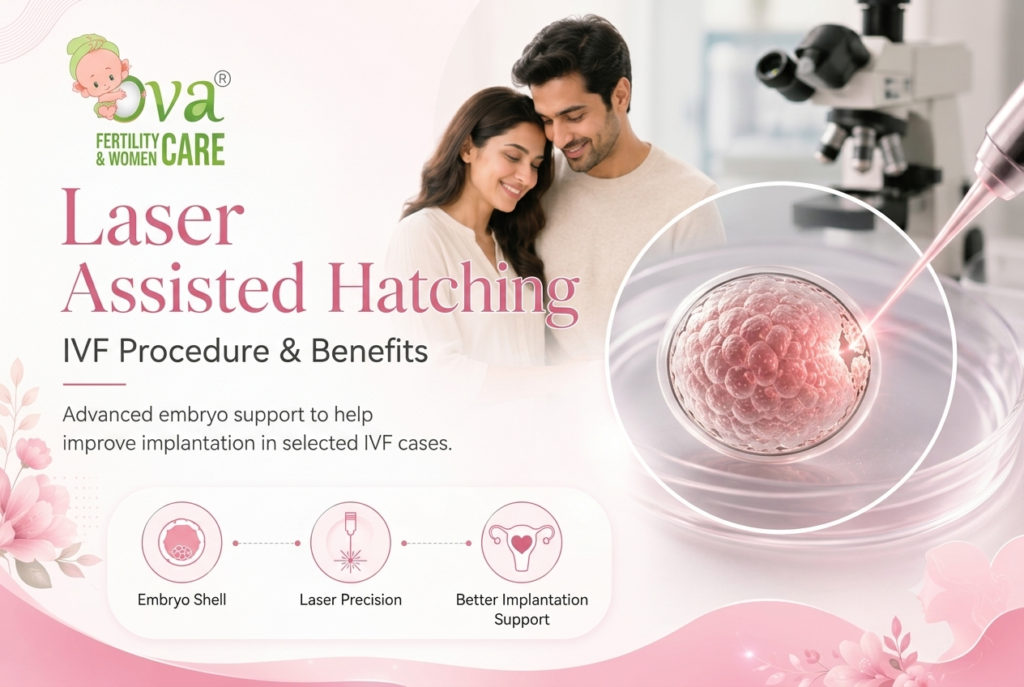
Laser Assisted Hatching Treatment: IVF Procedure, Benefits & Who May Need It
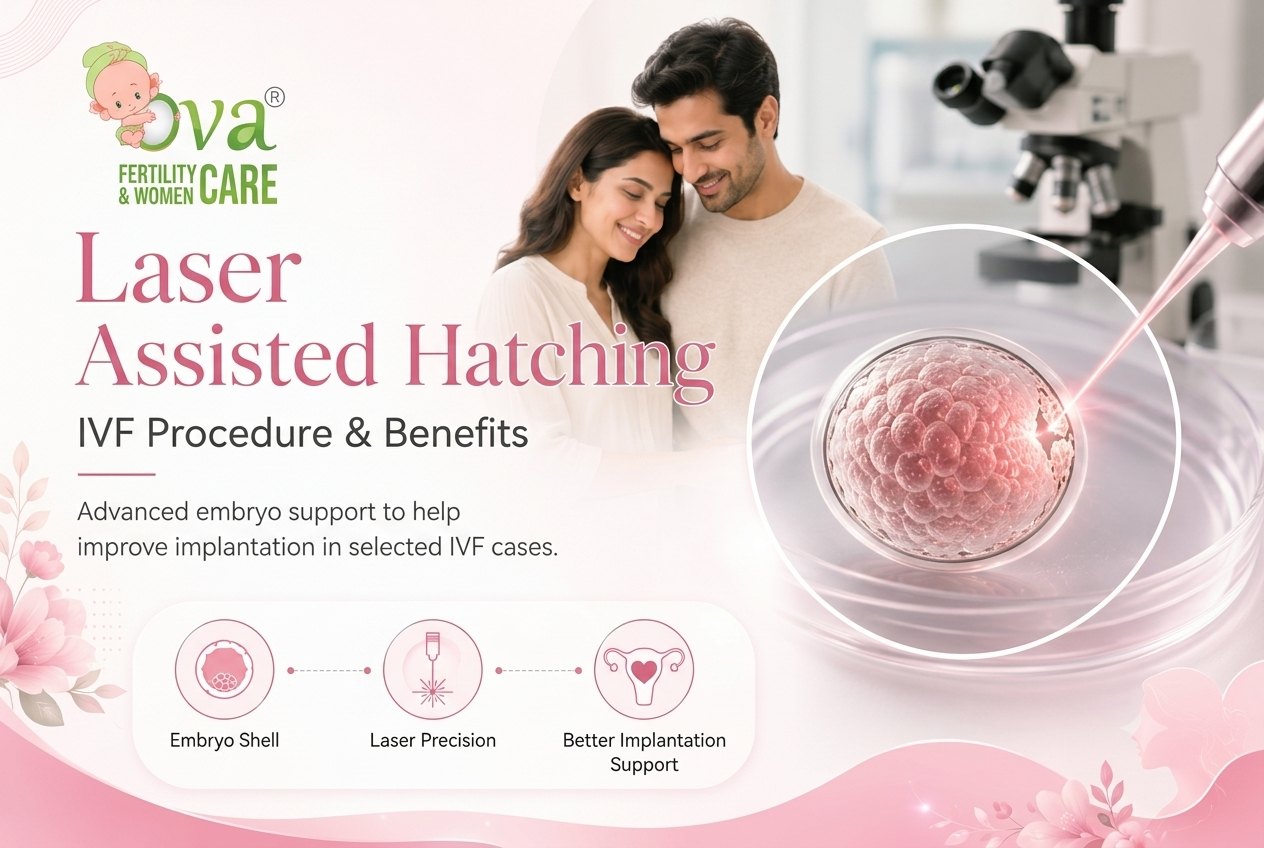
Laser assisted hatching is an advanced IVF technique used to support embryo implantation in selected fertility cases. During IVF, an embryo has to “hatch” from its outer covering before it can attach to the uterine lining. In some situations, this outer layer may be slightly thick or difficult for the embryo to break through. Laser assisted hatching helps by creating a very small opening in this outer shell before embryo transfer.
For couples going through IVF, every stage matters. Egg quality, sperm quality, fertilization, embryo development, uterus preparation, embryo transfer, and implantation all play an important role. Even after forming a good embryo, pregnancy can happen only when the embryo implants successfully inside the uterus.
At Ova Fertility and Women Care, laser assisted hatching is offered as part of advanced fertility care, along with IVF/ICSI, blastocyst culture, Pre-implantation Genetic Testing, egg/sperm/embryo freezing, male infertility care, fertility-enhancing endoscopy, and counselling. Ova Care’s fertility approach focuses on complete women’s care under one roof, with advanced treatment options and personalized support for couples.
This blog explains laser assisted hatching in simple language – what it means, how it works, who may need it, its benefits, limitations, safety, and how it fits into the IVF journey.
What Is Laser Assisted Hatching?
Laser assisted hatching is a laboratory technique used during IVF where a precise laser is used to make a tiny opening in the outer covering of an embryo. This outer covering is called the zona pellucida.
The zona pellucida protects the embryo during early development. But before implantation, the embryo must naturally come out of this covering. This process is called hatching.
In some IVF cases, the embryo may need support to hatch properly. Laser assisted hatching helps by thinning or opening the outer shell so that the embryo may come out more easily before implantation.
Ova Fertility and Women Care explains laser assisted hatching as a method that creates a small opening in the embryo’s outer shell to help improve the chances of implantation in selected patients.
Why Is Hatching Important in IVF?
To understand laser assisted hatching properly, it helps to understand natural embryo hatching.
After fertilization, the embryo starts developing inside a protective outer layer called the zona pellucida. This layer stays around the embryo during early development. When the embryo reaches the right stage, it must break out of this covering before it can attach to the uterus.
This natural breaking-out process is called hatching.
Only after hatching can the embryo come in direct contact with the uterine lining and begin implantation. If hatching does not happen properly, implantation may become difficult.
In a natural pregnancy, this process happens inside the woman’s reproductive tract. In IVF, embryos are created and grown in the laboratory for a few days before being transferred into the uterus. For some patients, assisted hatching may be considered to support this process.
What Is the Zona Pellucida?
The zona pellucida is the thin outer covering around the egg and early embryo. It has an important role during fertilization and early embryo development.
The zona pellucida helps by:
- Protecting the egg before fertilization
- Supporting sperm-egg interaction
- Keeping early embryo cells together
- Protecting the embryo during early development
- Preventing abnormal fertilization by multiple sperm
But when the embryo is ready for implantation, it must come out of this shell. If the zona pellucida is thick, hard, or does not allow proper hatching, the embryo may struggle to implant.
Laser assisted hatching is used to support this step in selected IVF cases.
How Does Laser Assisted Hatching Work?
Laser assisted hatching is performed in the IVF laboratory before embryo transfer. It is not done inside the woman’s body. The patient does not feel the laser procedure because it is performed on the embryo outside the body.
The embryologist uses a special laser system under a microscope to make a tiny opening in the zona pellucida. The laser is controlled very precisely, so the opening is created without physically touching the embryo.
The general process includes:
- Embryos are created through IVF or ICSI
- Embryos are grown in the IVF lab for a few days
- The embryologist selects embryos for transfer
- A precise laser is used to make a small opening in the outer shell
- The embryo is transferred into the uterus
- The embryo may hatch and attach to the uterine lining
The aim is not to damage the embryo. The aim is to gently support the hatching process.
When Is Laser Assisted Hatching Done During IVF?
Laser assisted hatching is usually done shortly before embryo transfer. The exact timing depends on the embryo stage and the fertility specialist’s plan.
It may be performed on:
- Day 3 embryos
- Blastocyst-stage embryos
- Frozen-thawed embryos before transfer
- Embryos selected for transfer in specific IVF cases
The decision depends on embryo quality, embryo stage, patient age, previous IVF history, and clinical need.
It is not automatically required for every embryo or every IVF cycle.
Add Your Heading Text Here
Who May Need Laser Assisted Hatching?
Laser assisted hatching is usually suggested only for selected couples. It is not a routine requirement for all IVF patients.
A fertility specialist may consider laser assisted hatching in cases such as:
- Repeated IVF failure
- Previous failed embryo transfers
- Advanced maternal age
- Thick zona pellucida
- Frozen embryo transfer
- Poor embryo hatching history
- Low implantation in earlier cycles
- Certain cases of poor embryo quality
- Selected patients with unexplained implantation failure
Ova Care mentions that assisted hatching may improve implantation and pregnancy rates in selected groups, which means the procedure should be used thoughtfully and based on individual case assessment.
Laser Assisted Hatching After Failed IVF Cycles
A failed IVF cycle can be emotionally very difficult. Many couples wonder why pregnancy did not happen even when embryo transfer was done properly.
There can be many reasons behind IVF failure, including:
- Embryo quality
- Chromosomal abnormalities
- Uterine lining issues
- Hormonal imbalance
- Implantation difficulty
- Sperm or egg quality concerns
- Endometriosis or adenomyosis
- Immune or clotting-related factors in selected cases
- Timing of embryo transfer
Sometimes, one possible concern is that the embryo may not hatch properly from its outer shell. In such cases, laser assisted hatching may be considered as part of the next IVF plan.
However, it is important to understand that laser assisted hatching is not a guaranteed solution for failed IVF. It is one supportive technique. A complete fertility review is still needed.
At Ova Fertility and Women Care, fertility treatment is planned with a personalized approach, including IVF/ICSI, blastocyst culture, genetic testing, endoscopy support, male infertility evaluation, and counselling when required.
Laser Assisted Hatching and Advanced Maternal Age
As a woman’s age increases, both egg quality and embryo quality may be affected. In some cases, the zona pellucida may also become thicker or harder, making hatching more difficult.
For women of advanced maternal age, especially in IVF cycles with previous implantation failure, the fertility specialist may consider laser assisted hatching.
That said, age alone does not mean every woman needs this procedure. The decision depends on the full IVF picture, including:
- Ovarian reserve
- Embryo quality
- Previous IVF history
- Number of embryos
- Uterine lining
- Fertility diagnosis
- Embryologist’s assessment
A good IVF plan should not be based on just one factor. It should be personalized.
Laser Assisted Hatching and Frozen Embryo Transfer
Laser assisted hatching may sometimes be considered in frozen embryo transfer cycles.
When embryos are frozen and later thawed, the outer shell may become slightly harder in some cases. This does not mean frozen embryos cannot implant naturally. Many frozen embryo transfers work well without assisted hatching. But in selected cases, the fertility team may advise assisted hatching before transfer.
Ova Fertility and Women Care offers egg, sperm, and embryo freezing as part of fertility services, along with IVF, ICSI, blastocyst culture, laser assisted hatching, and related advanced IVF care.
Laser Assisted Hatching and Blastocyst Transfer
Blastocyst transfer means transferring an embryo that has reached an advanced development stage, usually around day 5 or day 6 after fertilization.
Some blastocysts naturally start hatching before transfer. Others may still be inside the outer shell. Assisted hatching may be considered in selected cases depending on the blastocyst stage, shell appearance, and IVF history.
At Ova Care, blastocyst culture and transfer is part of advanced fertility treatment, and laser assisted hatching is also listed as a fertility service.
The decision to use laser assisted hatching during blastocyst transfer depends on the embryologist and fertility specialist’s judgment.
Benefits of Laser Assisted Hatching
Laser assisted hatching can be helpful for selected IVF patients. Its main purpose is to support the embryo’s ability to hatch from the zona pellucida and implant into the uterus.
Possible benefits include:
- May support embryo hatching
- May improve implantation chances in selected cases
- Useful in some repeated IVF failure cases
- Helpful when the embryo shell appears thick
- May be considered in frozen embryo transfer cycles
- Uses a precise laser instead of mechanical handling
- May support embryo transfer planning in advanced IVF care
The key phrase here is “selected cases.” Laser assisted hatching should not be presented as a magic step for everyone. It works best when used for the right indication.
Is Laser Assisted Hatching Safe?
Laser assisted hatching is considered a safe method when performed by trained embryology professionals in a proper IVF laboratory. The laser allows controlled, precise opening of the embryo’s outer shell.
Ova Fertility and Women Care’s laser assisted hatching page describes it as a safe method that does not harm the embryo when compared with other methods.
However, like any IVF laboratory technique, it should be done only when needed and only by an experienced embryology team. The embryo must be handled carefully throughout the process.
Does Laser Assisted Hatching Guarantee Pregnancy?
No. Laser assisted hatching does not guarantee pregnancy.
It may support implantation in selected cases, but IVF success depends on many factors.
Pregnancy success may depend on:
- Age of the woman
- Egg quality
- Sperm quality
- Embryo quality
- Chromosomal health of the embryo
- Uterine lining thickness
- Hormonal support
- Timing of transfer
- Previous IVF history
- Medical conditions such as endometriosis or fibroids
- Lifestyle and overall health
Laser assisted hatching is only one supportive technique in the IVF process. It can help in the right situation, but it cannot correct all causes of IVF failure.
This is why couples should receive honest counselling before choosing the procedure.
Laser Assisted Hatching vs Natural Hatching
In natural hatching, the embryo breaks out of its outer shell on its own before implantation. In laser assisted hatching, a small opening is created in the shell to support this process.
Natural hatching:
- Happens on its own
- Does not need lab intervention
- Works well in many embryos
- Is part of normal embryo development
Laser assisted hatching:
- Is done in the IVF lab
- Uses a controlled laser beam
- Creates a small opening in the zona pellucida
- May support embryos that may struggle to hatch
- Is usually considered for selected IVF cases
The goal of assisted hatching is not to replace natural development. It is to give support where hatching difficulty may be suspected.
Laser Assisted Hatching vs Other Assisted Hatching Methods
Earlier, assisted hatching could be done by mechanical or chemical methods. Laser assisted hatching is now preferred in many advanced IVF setups because it is more controlled and precise.
Laser assisted hatching may offer:
- Better precision
- Faster procedure
- Less physical handling
- Controlled opening size
- Reduced mechanical stress compared with older methods
- Better visualization under microscope
This is one reason laser technology is used in advanced embryology labs.
What Happens Before Laser Assisted Hatching?
Before laser assisted hatching is planned, the couple goes through the IVF process.
Before the procedure, the IVF journey may include:
- Fertility consultation
- Ovarian stimulation
- Follicle monitoring
- Egg retrieval
- Sperm collection
- IVF or ICSI fertilization
- Embryo culture
- Embryo selection
- Decision about assisted hatching
- Embryo transfer planning
The fertility specialist and embryologist decide whether assisted hatching is suitable based on embryo condition and patient history.
What Happens After Laser Assisted Hatching?
After laser assisted hatching, the embryo is transferred into the uterus. The woman may be advised to continue hormonal medicines and follow post-transfer instructions.
After transfer, the waiting period begins. This phase can feel emotionally intense because couples naturally hope for a positive result.
After embryo transfer, patients may be advised to:
- Take prescribed medicines on time
- Avoid heavy physical strain
- Follow doctor’s instructions
- Avoid self-medication
- Stay calm as much as possible
- Avoid repeated home pregnancy tests too early
- Visit for the pregnancy test on the advised date
The embryo still needs to implant naturally. Assisted hatching supports one part of the process, but the body and embryo must complete the remaining steps.
Is Laser Assisted Hatching Painful?
No, laser assisted hatching itself is not painful for the woman because it is done on the embryo in the IVF laboratory before embryo transfer.
The patient does not feel the laser procedure. She only goes through the usual IVF steps such as injections, egg retrieval, and embryo transfer, depending on the treatment plan.
Embryo transfer is usually a simple procedure and may cause only mild discomfort in some women.
Can Laser Assisted Hatching Damage the Embryo?
When done by trained embryologists using proper laser systems, the procedure is designed to avoid embryo damage. The laser targets only the outer shell and not the embryo cells.
Still, embryo handling requires skill. That is why the experience of the IVF lab and embryology team matters.
Couples should feel comfortable asking the fertility team why assisted hatching is being recommended and how it fits into their IVF plan.
Is Laser Assisted Hatching Needed in Every IVF Cycle?
No. Laser assisted hatching is not needed in every IVF cycle.
Many embryos hatch naturally without any additional help. If embryo quality is good, the patient is younger, there is no previous implantation failure, and the embryologist does not see any concern with the zona pellucida, assisted hatching may not be needed.
It may be considered when there is a specific reason, such as repeated IVF failure, thick outer shell, frozen embryo transfer, or selected age-related concerns.
A personalized approach is better than adding every advanced technique to every IVF cycle.
Laser Assisted Hatching and Embryo Quality
Laser assisted hatching can help the embryo come out of the shell, but it cannot turn a poor-quality embryo into a good-quality embryo.
This is important to understand.
Embryo quality depends on egg quality, sperm quality, fertilization, chromosomal health, and embryo development. Assisted hatching may support implantation only if the embryo is otherwise capable of developing further.
So, if embryo quality is poor, laser assisted hatching may not solve the core issue. The fertility team may need to review the complete IVF history.
Laser Assisted Hatching and Implantation Failure
Implantation failure means the embryo does not attach to the uterine lining after transfer. This can happen even when the embryo looks good.
Possible causes include:
- Embryo genetic abnormality
- Poor embryo development
- Uterine lining issues
- Endometrial receptivity problems
- Fibroids or polyps
- Adenomyosis
- Endometriosis
- Hormonal imbalance
- Infection
- Blood flow issues
- Unknown causes
Laser assisted hatching may be considered if poor hatching is suspected. But in repeated implantation failure, the couple may need a broader evaluation.
At Ova Fertility and Women Care, IVF-related services are supported by fertility treatments, gynecology, endoscopy, ultrasound, male infertility evaluation, and counselling, which helps in understanding different possible causes behind fertility challenges.
Laser Assisted Hatching and PGT
Pre-implantation Genetic Testing, or PGT, is used in selected IVF cases to screen embryos for genetic or chromosomal abnormalities before transfer.
Laser technology may be used in advanced embryology procedures, including creating access to embryo cells for biopsy in some cases. Laser assisted hatching and PGT are different procedures, but both are part of advanced IVF laboratory care.
Ova Care offers Pre-implantation Genetic Testing as one of its fertility services, along with laser assisted hatching, IVF/ICSI, blastocyst culture, and embryo freezing.
The fertility specialist will explain which procedure is needed and why.
Emotional Side of Laser Assisted Hatching and IVF
When couples hear about “advanced IVF techniques,” they may feel both hopeful and nervous. Some may think, “Will this finally help?” Others may worry, “Does this mean our embryo has a problem?”
It is normal to feel this way.
Laser assisted hatching does not mean something is wrong with you. It simply means the fertility team is considering an additional support step based on your embryo or treatment history.
At Ova Fertility and Women Care, counselling is included among fertility services, which is important because IVF is not only a medical journey. It is also emotional, personal, and sometimes tiring.
Couples should ask questions, understand the reason for each step, and avoid comparing their treatment with someone else’s journey.
Questions to Ask Before Laser Assisted Hatching
Before agreeing to laser assisted hatching, couples can ask the fertility specialist:
- Why is laser assisted hatching recommended in our case?
- Is the embryo shell thick?
- Have our previous IVF failures suggested implantation difficulty?
- Is this needed for fresh or frozen embryo transfer?
- Will it improve our chances?
- Are there any risks?
- Will it be done on all embryos or only selected embryos?
- Who performs the procedure?
- What happens after assisted hatching?
- Does this change the embryo transfer plan?
Clear answers can make the IVF process feel less confusing.
People Also Ask: What Is Laser Assisted Hatching in IVF?
Laser assisted hatching in IVF is a laboratory technique where a small opening is made in the embryo’s outer shell using a laser. This may help the embryo hatch and attach to the uterine lining before implantation.
People Also Ask: Is Laser Assisted Hatching Safe?
Laser assisted hatching is considered safe when performed by trained embryologists in a proper IVF laboratory. The laser is used precisely on the outer shell of the embryo. It should be done only when medically suitable.
People Also Ask: Does Laser Assisted Hatching Improve IVF Success?
Laser assisted hatching may improve implantation chances in selected IVF cases, such as repeated IVF failure, thick embryo shell, frozen embryo transfer, or advanced maternal age. However, it does not guarantee pregnancy.
People Also Ask: Is Laser Assisted Hatching Painful?
No. Laser assisted hatching is not painful for the woman because it is done on the embryo in the IVF lab before transfer. The patient only undergoes the usual IVF treatment steps and embryo transfer process.
People Also Ask: Who Should Consider Laser Assisted Hatching?
Laser assisted hatching may be considered for couples with repeated failed IVF cycles, previous implantation failure, thick zona pellucida, frozen embryo transfer, advanced maternal age, or selected embryo development concerns.
Why Choose Ova Fertility and Women Care for Laser Assisted Hatching?
Ova Fertility and Women Care provides fertility, maternity, gynecology, endoscopy, pediatric, ultrasound, and lifestyle support services with a focus on complete women’s care under one roof. The fertility services include ovulation induction, ultrasound, IUI, IVF/ICSI, blastocyst culture, laser-assisted hatching, genetic testing, male infertility care, egg/sperm/embryo freezing, counselling, and oncofertility.
For laser assisted hatching, the IVF lab and embryology support are very important because the procedure is performed at the embryo level. Ova Care’s IVF services are supported by advanced fertility care and personalized treatment planning for couples looking for fertility support in Thane and Mumbai.
Ova Care supports couples with:
- IVF and ICSI treatment
- Laser assisted hatching
- Blastocyst culture and transfer
- Pre-implantation Genetic Testing
- Egg, sperm, and embryo freezing
- Male infertility evaluation
- Fertility-enhancing endoscopy
- Ultrasound monitoring
- Counselling and emotional support
- Personalized fertility planning
The goal is not to add unnecessary procedures, but to choose the right treatment support based on each couple’s fertility condition.
Conclusion
Laser assisted hatching is an advanced IVF technique that may help selected embryos hatch from their outer shell before implantation. It is performed in the IVF laboratory using a precise laser and may be useful in cases such as repeated IVF failure, thick zona pellucida, frozen embryo transfer, advanced maternal age, or selected implantation concerns.
However, laser assisted hatching is not needed for every IVF cycle. It also does not guarantee pregnancy. IVF success depends on many factors, including embryo quality, uterine lining, egg and sperm health, hormones, and overall fertility condition.
At Ova Fertility and Women Care, couples can receive guidance for IVF, ICSI, laser assisted hatching, blastocyst culture, Pre-implantation Genetic Testing, embryo freezing, male infertility care, and fertility counselling. With the right evaluation and a personalized plan, couples can better understand whether laser assisted hatching is suitable for their IVF journey.