




Difference Between Adolescence and Puberty: Complete Guide for Parents and Teens
Difference between adolescence and puberty is something many parents, teenagers, and even young adults are confused about. These two words are often used together, and sometimes people use them as if they mean the same thing. But they are not exactly the same.
Puberty is mainly about the physical and hormonal changes that prepare the body for reproductive maturity. Adolescence is a larger stage of development that includes puberty, but also includes emotional, social, mental, behavioural, and psychological changes.
So, in very simple words:
Puberty is a part of adolescence, but adolescence is much more than puberty.
At Ova Fertility and Women Care, adolescent health is seen as an important part of complete women’s care. Ova Care provides women’s healthcare services across life stages, from adolescence to menopause, with gynecology, fertility, maternity, endoscopy, ultrasound, lifestyle management, and emotional support under one roof.
This blog explains the difference between adolescence and puberty in simple language, especially for parents and teenage girls who may be trying to understand body changes, periods, emotions, hormones, and reproductive health.
Puberty is the stage when a child’s body starts changing into an adult body. It happens because of hormonal changes. During puberty, the body begins preparing for reproductive maturity.
In girls, puberty usually includes breast development, growth of pubic and underarm hair, body shape changes, height growth, skin changes, mood changes, and the start of menstruation.
For many girls, the first period becomes the most noticeable sign of puberty. But puberty actually starts before the first period. Breast development, body growth, and hormonal changes may begin earlier.
Featured Snippet Answer: What is puberty?
Puberty is the biological stage when a child’s body goes through physical and hormonal changes that lead to reproductive maturity. In girls, puberty may include breast development, body hair growth, height increase, body shape changes, acne, mood changes, and the start of periods.
What Is Adolescence?
Adolescence is the broader phase between childhood and adulthood. It includes puberty, but it also includes emotional growth, mental development, social changes, identity formation, independence, confidence, decision-making, and personality development.
A teenager does not only go through body changes. She also starts thinking differently, feeling more deeply, becoming more aware of herself, comparing herself with others, and wanting more privacy and independence.
This is adolescence.
It is not just about periods or physical growth. It is also about how a young person understands herself, her emotions, her body, her relationships, and her future.
Featured Snippet Answer: What is adolescence?
Adolescence is the transition stage from childhood to adulthood. It includes physical changes of puberty as well as emotional, psychological, social, and behavioural development. Adolescence affects how teenagers think, feel, relate to others, make decisions, and understand their identity.
Simple Difference Between Adolescence and Puberty
The easiest way to understand the difference is this:
Puberty is body change. Adolescence is life-stage change.
Puberty mainly focuses on hormones and physical development. Adolescence includes puberty but also includes emotional maturity, mental growth, social behaviour, confidence, self-image, relationships, and independence.
Difference between adolescence and puberty at a glance
Point | Puberty | Adolescence |
Meaning | Physical and hormonal development | Overall transition from childhood to adulthood |
Main focus | Body and reproductive maturity | Body, mind, emotions, behaviour, identity |
Includes periods? | Yes, in girls | Yes, but as part of overall growth |
Duration | Usually shorter | Usually longer |
Changes | Breast growth, body hair, periods, height growth | Emotional changes, social changes, self-awareness, decision-making |
Medical focus | Hormonal and reproductive development | Physical, mental, emotional, and social wellbeing |
Example | A girl gets her first period | A girl learns to manage emotions, body changes, peer pressure, studies, privacy, and confidence |
Why People Confuse Puberty and Adolescence
People confuse these terms because puberty happens during adolescence. A teenager may experience periods, mood swings, body growth, emotional sensitivity, and identity changes around the same time. So, everything feels connected.
For example, a girl may get her first period and also become more private, emotional, or sensitive about her appearance. Parents may think all of this is puberty. Actually, some of it is puberty, and some of it is adolescence.
Both are connected, but not identical.
Puberty explains what is happening in the body.
Adolescence explains what is happening in the overall person.
Why Understanding This Difference Matters
Understanding the difference between adolescence and puberty helps parents respond better. Many teenage girls are not “being difficult” on purpose. Their body is changing, their hormones are shifting, and their mind is also developing.
When parents understand this, they can support their daughter with more patience.
This understanding also helps girls feel less scared. When body changes happen without explanation, a teenager may think something is wrong with her. But when she is guided properly, she can feel more confident and prepared.
At Ova Fertility and Women Care, adolescent health is part of the gynecology and women’s health service structure, and the website lists Puberty Adolescence as a dedicated service under Gynaecology & Endoscopy.
Physical Changes During Puberty in Girls
Puberty brings many visible and invisible changes. Some girls go through these changes early, while some experience them later. This variation is usually normal, but very early or very delayed puberty should be discussed with a gynecologist.
Common physical changes include:
- Breast development
- Growth of pubic and underarm hair
- Height increase
- Wider hips
- Body shape changes
- Acne or oily skin
- Body odour
- Vaginal discharge
- Start of periods
- Weight changes
- Cramps or premenstrual symptoms
These changes can feel confusing at first. A girl may feel shy about breast development, worried about weight changes, or scared when periods start. Proper education makes this phase much easier.
Emotional Changes During Adolescence
Adolescence is not only physical. Emotions can become stronger during this stage. A teenager may feel happy one moment and upset the next. She may want independence but still need comfort. She may argue more, but also feel more sensitive.
This does not mean something is wrong. Emotional development is part of adolescence.
Common emotional changes include:
- Mood swings
- Increased sensitivity
- Need for privacy
- Body image concerns
- Self-consciousness
- Fear of judgement
- Stronger friendships
- Attraction or relationship curiosity
- Academic pressure
- Anxiety about appearance
- Desire for independence
Parents should avoid making fun of these emotions. What looks small to an adult may feel very big to a teenager.
Psychological Changes During Adolescence
During adolescence, teenagers start developing their own thoughts, opinions, and identity. They may question rules, compare themselves with friends, and become more aware of social acceptance.
This phase can influence confidence and self-esteem deeply.
Psychological changes may include:
- Developing personal identity
- Comparing body and appearance
- Becoming more independent
- Thinking about future goals
- Questioning family rules
- Feeling peer pressure
- Becoming aware of gender and sexuality
- Experiencing stress from school or social life
- Wanting emotional validation
A supportive home environment can help teenagers build confidence during this stage.
Hormonal Changes: The Link Between Puberty and Adolescence
Hormones are the main reason puberty begins. These hormones also influence mood, skin, body shape, periods, and sometimes emotional responses.
In girls, hormonal changes support ovarian function, menstrual cycle development, breast growth, and reproductive maturity.
But hormones do not act alone. Sleep, diet, stress, screen time, physical activity, emotional environment, and health conditions can also affect teenage wellbeing.
This is why adolescent care should not focus only on periods. It should also include lifestyle, emotional health, nutrition, menstrual hygiene, and body confidence.
First Period: A Major Puberty Milestone
The first period is called menarche. For many girls, it is the most memorable sign of puberty. Some feel excited. Some feel scared. Some feel embarrassed. Some do not understand what is happening.
Girls should ideally learn about periods before they start. This prevents panic and shame.
Parents should explain:
- Periods are normal
- Bleeding happens from the uterus
- It is not a wound or injury
- Hygiene is important
- Mild cramps can happen
- Periods may be irregular at first
- Tracking dates is helpful
- Heavy pain or very heavy bleeding should be checked
A calm conversation before the first period can make a big difference.
Are Irregular Periods Normal During Puberty?
Periods may be irregular during the first few years after they start. This is because the hormonal cycle is still maturing. A girl may get periods early, late, or with changing flow patterns.
However, not every irregular period should be ignored.
A gynecologist consultation is helpful if:
- Periods are extremely heavy
- Period pain is severe
- Bleeding lasts more than seven days
- Periods are absent for several months
- Cycles remain very irregular for a long time
- There is excessive acne or facial hair growth
- There is sudden weight gain
- There is dizziness or weakness during periods
- Periods start very early or very late
Sometimes irregular periods may be linked with PCOS, thyroid imbalance, stress, nutritional issues, or hormonal problems.
Ova Care’s gynecology services include care for menstrual irregularities, hormonal imbalance, PCOS, pelvic pain, endometriosis, fibroids, pregnancy care, and menopause-related concerns, supporting women from adolescence to menopause.
Puberty in Boys vs Girls: A Simple Note
Although this blog is focused on Ova Care’s women’s health audience, it helps to understand that puberty happens in boys too. Boys may experience voice changes, facial hair, muscle growth, height increase, and reproductive maturity.
Girls usually notice breast development and periods as major puberty signs. Boys may notice voice changes and facial hair more clearly.
Adolescence, however, affects both boys and girls emotionally and socially.
Early Puberty: When Changes Start Too Soon
Early puberty means puberty signs begin much earlier than expected. In girls, this may include early breast development, early pubic hair growth, rapid height increase, or periods starting too young.
Early puberty can be emotionally difficult because the child’s body changes before she is mentally ready. She may feel different from classmates or become self-conscious.
Possible concerns with early puberty include:
- Emotional discomfort
- Early periods
- Height concerns
- Body image issues
- Hormonal imbalance
- Need for medical evaluation
If parents notice puberty signs very early, they should consult a doctor instead of waiting silently.
Delayed Puberty: When Changes Start Late
Delayed puberty means puberty changes do not begin within the expected age range. Some girls develop later naturally, especially if there is a family history of late development. But delayed puberty may also be linked with nutrition, chronic illness, hormonal conditions, thyroid issues, or ovarian concerns.
Signs that may need evaluation include:
- No breast development by expected age
- No periods even after other puberty signs
- Very slow growth
- Very low body weight
- Excessive exercise and missed periods
- Chronic illness symptoms
- Delayed development compared with peers
A doctor can guide whether it is normal variation or needs medical care.
Body Image Concerns During Adolescence
Adolescence is a time when girls become more aware of their bodies. They may compare height, weight, skin, breast size, hair growth, body shape, and complexion with friends or social media images.
This can affect confidence.
Parents should be careful with comments like:
- “You are gaining too much weight.”
- “Your skin is looking bad.”
- “Why are you so short?”
- “Your friend looks healthier.”
- “You should not eat so much.”
Such comments may sound casual to adults but can stay in a teenager’s mind for years.
Instead, focus on health, not appearance.
Say things like:
- “Let’s build a healthy routine.”
- “Your body is growing, and changes are normal.”
- “We can speak to a doctor if you are worried.”
- “You do not have to compare yourself with anyone.”
Menstrual Hygiene During Puberty
Menstrual hygiene is one of the most important parts of puberty education. Many girls learn about periods from friends or social media, and not all information is correct.
Teenage girls should be guided about:
- How to use pads properly
- How often to change pads
- How to dispose of pads safely
- Washing hands before and after changing
- Wearing comfortable underwear
- Tracking period dates
- Managing cramps safely
- Recognizing abnormal bleeding
- Avoiding shame around periods
Good menstrual hygiene prevents discomfort, infections, embarrassment, and fear.
Acne, Hair Growth, and Hormonal Changes
Acne and oily skin are common during puberty because hormones influence oil glands. Some girls may also notice hair growth on the face, arms, legs, or abdomen.
Mild acne and body hair can be normal. But excessive acne, facial hair growth, irregular periods, and weight gain together may suggest PCOS or hormonal imbalance.
Teenagers should not be shamed for these symptoms. They need support and medical guidance if symptoms are significant.
Nutrition During Puberty and Adolescence
Teenage years are a growth phase. The body needs enough nutrition for bone health, muscle development, hormones, periods, immunity, and energy.
Helpful nutrition habits include:
- Eating regular meals
- Including protein in diet
- Eating fruits and vegetables
- Drinking enough water
- Avoiding crash diets
- Avoiding skipping breakfast
- Limiting junk food
- Taking iron-rich foods
- Including calcium-rich foods
- Avoiding extreme weight-loss methods
Teenage girls are at risk of anemia, especially after periods begin. Tiredness, dizziness, pale skin, poor concentration, or heavy bleeding should be checked.
Mental Health During Adolescence
Teenagers can experience stress from studies, friendships, social media, body image, family expectations, and future pressure. Sometimes emotional changes are normal. But sometimes they may need attention.
Parents should watch for:
- Withdrawal from family
- Persistent sadness
- Sudden anger
- Loss of interest in activities
- Sleep problems
- Eating changes
- Self-harm talk
- Excessive fear or anxiety
- Drop in school performance
- Strong body image distress
If these signs continue, professional support may be needed. Emotional care is not a weakness. It is part of health.
Ova Fertility and Women Care highlights medical and emotional support through specialist doctors, nurses, counsellors, and support staff, with patient communication and transparency as part of its care approach.
Parent’s Role During Puberty and Adolescence
Parents play a big role in how teenagers experience this phase. A calm, informed parent can make puberty and adolescence feel safe instead of scary.
Parents can help by:
- Talking openly about periods
- Not shaming body changes
- Respecting privacy
- Listening without judging
- Explaining hygiene clearly
- Supporting healthy eating
- Encouraging physical activity
- Watching for emotional distress
- Taking medical concerns seriously
- Avoiding comparison with siblings or friends
- Consulting a gynecologist when needed
Teenagers may not always ask directly. Sometimes they show discomfort through silence, anger, avoidance, or embarrassment.
Many parents think a teenager should visit a gynecologist only after marriage or pregnancy. That is not true.
A gynecologist can help teenage girls with period problems, puberty concerns, hormonal changes, PCOS symptoms, hygiene questions, pain, infections, and emotional concerns related to reproductive health.
Visit a gynecologist if there is:
- Very early puberty
- Delayed puberty
- No periods by expected age
- Very painful periods
- Very heavy periods
- Periods missing for months
- Excessive acne
- Facial hair growth
- Sudden weight gain
- White discharge with itching or smell
- Pelvic pain
- Breast concerns
- Anxiety around puberty changes
At Ova Care, gynecology care is described as covering women’s health from adolescence to menopause, with individualized treatment and clarity during the patient journey.
Adolescence and Reproductive Health Education
Adolescence is the right time to teach healthy reproductive awareness. This does not mean giving frightening or uncomfortable information. It means helping teenagers understand their bodies safely and respectfully.
Teenagers should know:
- Periods are natural
- Puberty changes are normal
- Consent and boundaries matter
- Hygiene is important
- Pain should not be ignored
- Online health advice can be misleading
- Self-medication is risky
- A doctor can help without judgement
- Emotional health matters too
When girls are educated properly, they grow with confidence and body awareness.
Difference Between Adolescence and Puberty in Daily Life
Let’s make this even simpler with a real-life example.
A 12-year-old girl starts developing breasts, gets acne, and later gets her first period. These are puberty changes.
The same girl also starts wanting privacy, feels embarrassed easily, becomes closer to friends, worries about looks, argues about rules, and starts thinking more independently. These are adolescence changes.
Both are happening together. But they are not the same.
Puberty explains physical maturity.
Adolescence explains overall growth into adulthood.
People Also Ask: Is Puberty the Same as Adolescence?
No, puberty and adolescence are not the same. Puberty is mainly about physical and hormonal changes. Adolescence is the larger stage of emotional, mental, social, behavioural, and physical development between childhood and adulthood.
People Also Ask: Does Adolescence Start Before Puberty?
Adolescence and puberty often overlap. Puberty usually begins during early adolescence, but adolescence includes many changes beyond puberty, such as emotional maturity, identity development, independence, and social behaviour.
People Also Ask: What Are the Main Signs of Puberty in Girls?
Common signs of puberty in girls include breast development, body hair growth, height increase, body shape changes, acne, body odour, vaginal discharge, and the start of periods.
People Also Ask: What Are Common Changes During Adolescence?
Adolescence may bring mood changes, self-consciousness, independence, stronger friendships, peer pressure, body image concerns, emotional sensitivity, decision-making changes, and future-related thoughts.
People Also Ask: When Should Parents Worry About Puberty Changes?
Parents should consult a doctor if puberty starts very early, is delayed, periods are extremely painful or heavy, periods are absent for months, or the teenager has severe acne, facial hair growth, sudden weight changes, or emotional distress.
Why Choose Ova Fertility and Women Care for Puberty and Adolescent Guidance?
Ova Fertility and Women Care supports women’s health across life stages, with services from adolescence to menopause under gynecology and complete women’s care. The hospital’s care model includes fertility, maternity, gynecology, endoscopy, ultrasound, lifestyle management, and emotional support under one roof.
For adolescent girls, this type of care matters because puberty and teenage development can involve physical, hormonal, emotional, and menstrual concerns together.
Ova Care can support adolescent health through:
- Puberty and adolescence guidance
- Menstrual health evaluation
- Irregular period assessment
- PCOS and hormonal imbalance care
- Period pain evaluation
- Heavy bleeding assessment
- Hygiene guidance
- Lifestyle and nutrition support
- Gynecology consultation
- Emotional support and counselling when needed
The goal is not to make teenagers feel like patients unnecessarily. The goal is to help them understand their body, manage symptoms early, and grow with confidence.
Conclusion
The difference between adolescence and puberty is simple once you understand it clearly. Puberty is the physical and hormonal process that prepares the body for reproductive maturity. Adolescence is the larger life stage that includes puberty along with emotional, psychological, social, and behavioural growth.
For teenage girls, this phase can feel confusing. Periods, body changes, acne, mood swings, privacy needs, peer pressure, and self-image concerns may all happen around the same time. With the right support from parents and doctors, this phase can become less stressful and more empowering.
At Ova Fertility and Women Care, puberty and adolescence guidance is part of complete women’s healthcare. With gynecology support, menstrual health evaluation, hormonal care, lifestyle guidance, and emotional support, teenage girls and parents can receive the right help at the right time.
Adolescence is not just a difficult phase to “handle.” It is a sensitive stage that needs understanding, patience, and guidance. When girls feel informed and supported, they grow into healthier and more confident women.
FAQ
1. What is the main difference between adolescence and puberty?
The main difference is that puberty refers to physical and hormonal changes, while adolescence is the broader transition from childhood to adulthood. Adolescence includes puberty, emotional development, social growth, decision-making, identity formation, and psychological changes.
2. Is puberty a part of adolescence?
Yes, puberty is a part of adolescence. Puberty mainly affects the body, while adolescence affects the body, mind, emotions, behaviour, and social life.
3. What are the signs of puberty in girls?
Signs of puberty in girls include breast development, pubic and underarm hair growth, height increase, body shape changes, acne, body odour, vaginal discharge, and the first period.
4. What emotional changes happen during adolescence?
During adolescence, teenagers may experience mood swings, emotional sensitivity, body image concerns, need for privacy, desire for independence, stronger friendships, peer pressure, anxiety, and self-consciousness.
5. Are irregular periods normal during puberty?
Irregular periods can be common during the first few years after periods begin. However, very heavy bleeding, severe pain, missed periods for months, excessive acne, facial hair growth, or sudden weight gain should be checked by a gynecologist.
6. When should parents take a teenage girl to a gynecologist?
Parents should consult a gynecologist if puberty starts too early, is delayed, periods are very painful or heavy, periods stop for months, or there are symptoms like severe acne, facial hair growth, pelvic pain, abnormal discharge, or major emotional distress.
7. Does Ova Fertility and Women Care provide puberty and adolescence guidance?
Yes. Ova Fertility and Women Care lists Puberty Adolescence under its gynecology and women’s health services and supports girls and women across different life stages with gynecology, hormonal, menstrual, lifestyle, and emotional care.
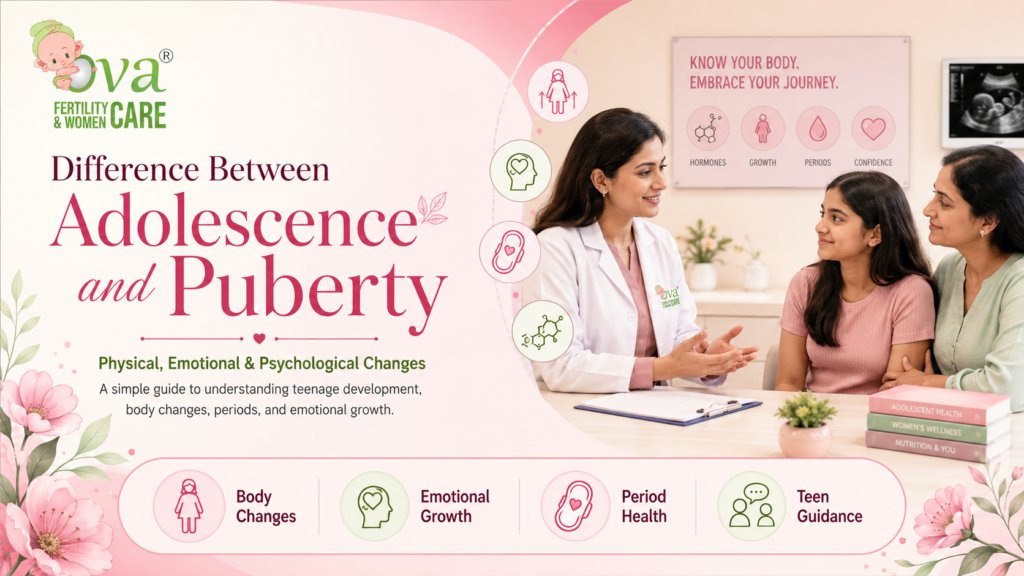
Table Of Content
- Difference Between Adolescence and Puberty: Complete Guide for Parents and Teens
- What Is Puberty?
- Featured Snippet Answer: What is puberty?
- What Is Adolescence?
- Simple Difference Between Adolescence and Puberty
- Why People Confuse Puberty and Adolescence
- Why Understanding This Difference Matters
- Physical Changes During Puberty in Girls
- Emotional Changes During Adolescence
- Psychological Changes During Adolescence
- Hormonal Changes: The Link Between Puberty and Adolescence
- First Period: A Major Puberty Milestone
- Are Irregular Periods Normal During Puberty?
- Puberty in Boys vs Girls: A Simple Note
- Early Puberty: When Changes Start Too Soon
- Delayed Puberty: When Changes Start Late
- Body Image Concerns During Adolescence
- Menstrual Hygiene During Puberty
- Acne, Hair Growth, and Hormonal Changes
- Nutrition During Puberty and Adolescence
- Mental Health During Adolescence
- Parent’s Role During Puberty and Adolescence
- When Should a Teenage Girl Visit a Gynecologist?
- Adolescence and Reproductive Health Education
- Difference Between Adolescence and Puberty in Daily Life
- Conclusion
- FAQ
