




Pre-Implantation Genetic Testing in Thane
Home » Pre-Implantation Genetic Testing (PGT) in Thane | Expert Care
Why The Ova Care Is Trusted as the Best Fertility and Maternity Hospital

Personalized Support

High Success Rate

24/7 Availablity

5000+ Successful Pregnancies

16+ Years of Experienced Experts

Affordable & Ethical Treatment
Pre-Implantation Genetic Testing in Thane
Pre-implantation genetic testing is recommended only when embryo genetics can meaningfully influence treatment decisions. It is not a routine add-on for every couple, and it is not a promise of pregnancy. At Ova Fertility & Women Care, pre-implantation genetic testing in Thane is offered with careful counselling, embryo-focused laboratory coordination, and responsible interpretation so couples understand what the test can reveal, what it cannot rule out, and how the result may affect embryo transfer planning.
PGT is performed during an assisted conception cycle before embryo transfer. After eggs are fertilized and embryos develop to the blastocyst stage, a few cells are carefully biopsied from the trophectoderm, the part that later forms the placenta. These cells are sent for genetic analysis while embryos are usually frozen and stored safely. Once the report is available, the fertility team discusses which embryos are suitable for transfer based on the type of test, embryo quality, medical history, and the couple’s reproductive goals.
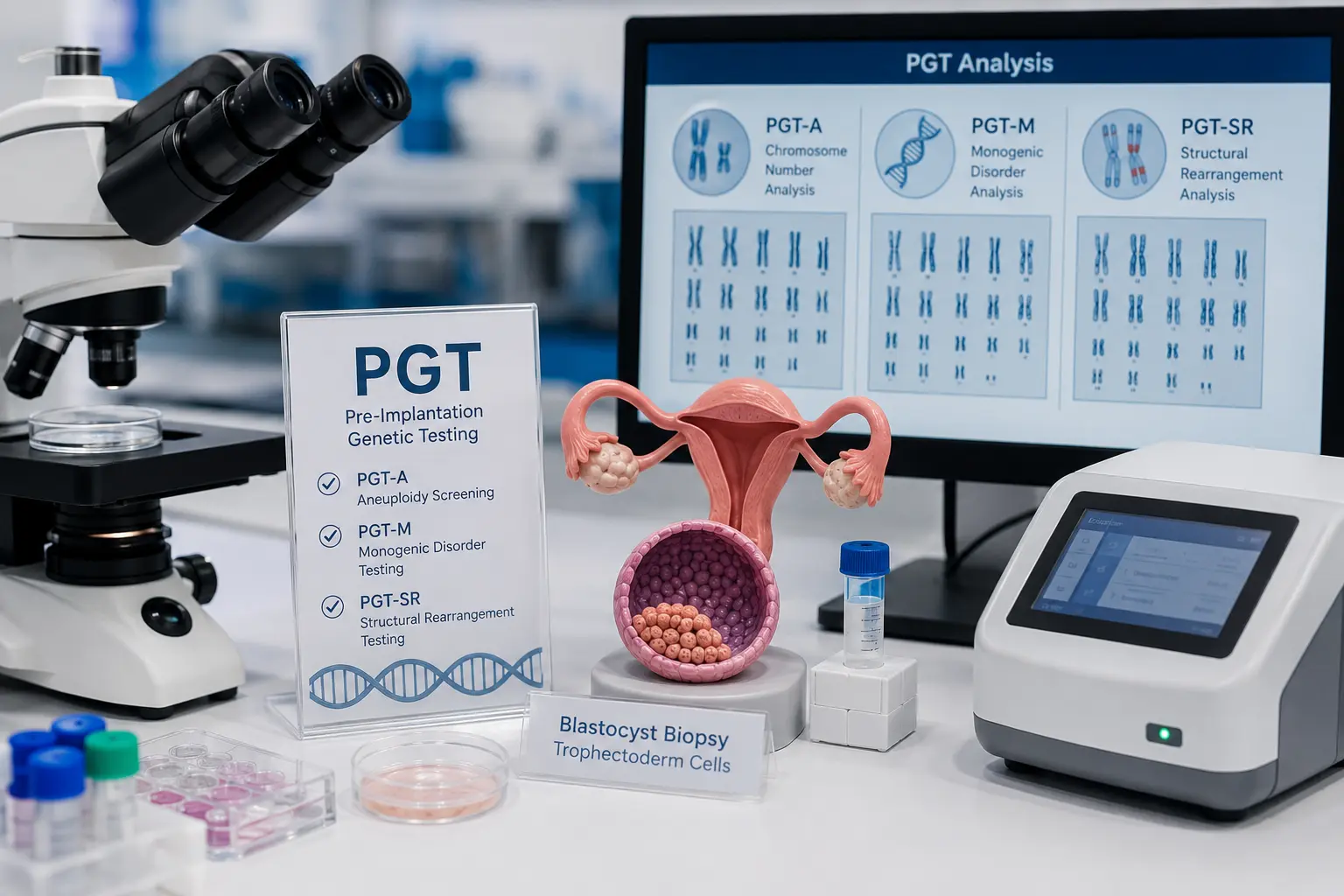
Why PGT Needs Specialist Counselling
The use of genetic testing before embryo transfer should never be presented as a shortcut in Thane. It is a sophisticated decision involving fertility medicine, embryology, genetics, ethics, and patient-specific risk. The same test may be very useful for one couple and unnecessary for another. A woman above 38 with repeated miscarriages, a couple carrying a known single-gene disorder, or a partner with a chromosomal rearrangement may benefit from testing. A young couple with good-prognosis embryos and no genetic history may not need it.
Is the concern age-related chromosomal abnormality? Recurrent pregnancy loss? Previous embryo-transfer failure? A known genetic disease in the family? A previous child affected by a disorder? A parental translocation? The answer determines whether PGT-A, PGT-M, or PGT-SR is appropriate. This distinction is essential because different PGT types answer different medical questions.
Understanding PGT, PGD, and PGS
Patients often hear several terms: PGT, PGD, PGS, PGT-A, PGT-M, and PGT-SR. Older terminology used PGD for diagnosis of specific inherited disorders and PGS for screening embryos for chromosomal number. Modern terminology places these under pre-implantation genetic testing.
PGT-A testing in Thane refers to pre-implantation genetic testing for aneuploidy. It checks whether an embryo has the expected number of chromosomes. Embryos with missing or extra chromosomes are more likely to fail implantation, miscarry, or result in chromosomal conditions. PGT-M testing in Thane is used when one or both partners carry a known single-gene condition, such as thalassemia, cystic fibrosis, Duchenne muscular dystrophy, Fragile X syndrome, sickle cell disease, Huntington disease, or another defined mutation. PGT-SR testing in Thane is used when a parent carries a structural chromosomal rearrangement, such as a balanced translocation, inversion, deletion, or duplication.
A precise diagnosis is needed before choosing the test. For PGT-M or PGT-SR, genetic reports of the couple or family may be required before the IVF cycle begins so the testing strategy can be prepared correctly.
Who Should Consider PGT Testing?
PGT testing in Thane may be considered for women of advanced reproductive age, especially when embryo aneuploidy risk is higher. It may also be considered for couples with recurrent miscarriage, repeated embryo-transfer failure, a previous pregnancy or child affected by a chromosomal condition, known carrier status for a genetic disorder, family history of serious inherited disease, or parental chromosomal rearrangement.
Embryo genetic testing in Thane may also be discussed when there are very limited embryos and the couple wants additional information before transfer, although this must be weighed carefully because biopsy and testing may not always improve outcome. In some cases, transferring a good-quality untested embryo may still be reasonable.
PGT should not be used casually for reassurance alone. It should be used when the result has a clear purpose: selecting against detectable chromosomal abnormality, reducing the chance of transferring embryos affected by a known genetic condition, or helping plan embryo transfer after repeated loss or failure.
What PGT Can and Cannot Do
Preimplantation genetic screening in Thane can help identify embryos with detectable chromosomal abnormalities or specific genetic risks, depending on the test chosen. It may reduce the chance of transferring embryos with abnormal chromosomal results. It may help lower miscarriage risk in selected patients and may reduce repeated transfers of embryos that are unlikely to implant.
However, PGT cannot guarantee implantation, pregnancy, live birth, or a completely healthy child. It cannot detect every possible genetic condition, birth defect, developmental concern, pregnancy complication, or disease that may occur later in life. A normal PGT result does not remove the need for routine antenatal care or prenatal screening advised during pregnancy.
At Ova, success counselling is individualized and never based on exaggerated promises.
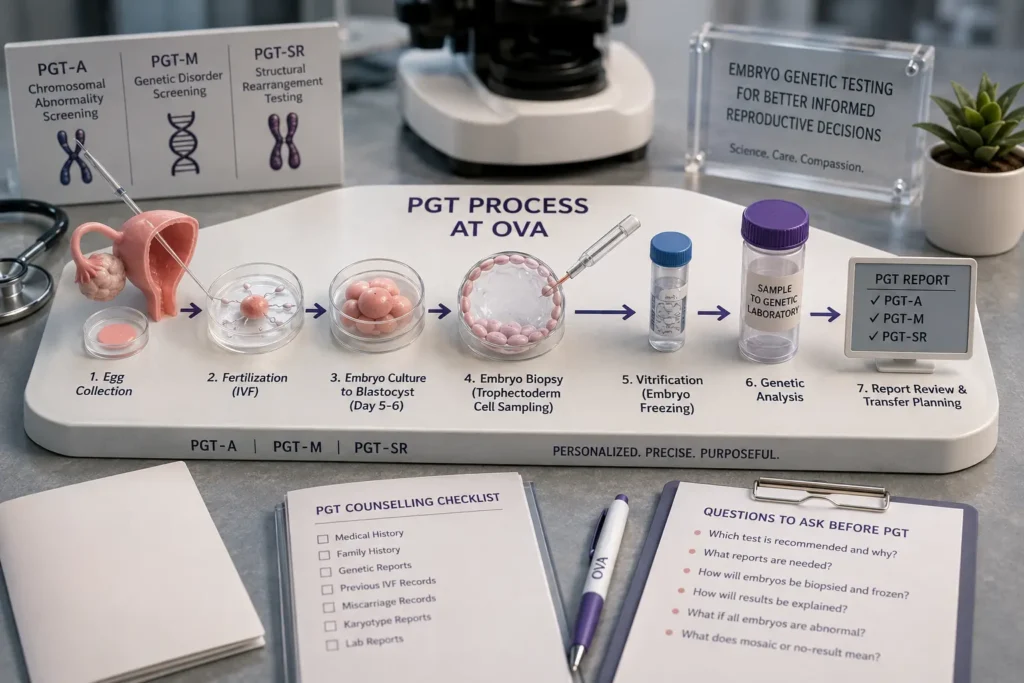
The PGT Process at Ova
The process begins with a consultation and review of medical history, age, previous pregnancies, miscarriages, Previous assisted cycles, embryo history, and genetic conditions in the family. If PGT-M or PGT-SR is being considered, genetic counselling and documentation become especially important before starting.
During the cycle, eggs are collected and fertilized in the laboratory. Embryos are cultured to blastocyst stage, usually day five or six, to allow biopsy to take place at that stage allowing a small number of trophectoderm cells to be sampled while preserving the inner cell mass, which forms the baby. The embryos are then vitrified, and the biopsy samples are sent to a genetic laboratory for analysis.
Once the report is available, the fertility team reviews the results with the couple. Embryos may be classified differently depending on test type and laboratory reporting. Transfer planning is then based on genetic results, embryo grade, uterine lining, hormone preparation, clinical safety, and patient preference after counselling.
PGT-A: Chromosomal Abnormality Screening
PGT-A looks for aneuploidy, meaning an abnormal number of chromosomes. The 46 chromosomes of a human are arranged into 23 pairs. When an embryo has extra or missing chromosomes, implantation may fail, miscarriage may occur, or a chromosomal condition may result. Aneuploidy becomes more common as maternal age increases, mainly because egg chromosomal division becomes less reliable with age.
PGT-A may be useful for selected couples with advanced maternal age, recurrent miscarriage, repeated unsuccessful transfers, or previous chromosomal abnormality. It can help prioritize embryos with expected chromosomal results for transfer. It may also reduce the need to transfer multiple embryos, supporting safer single-embryo transfer in appropriate cases.
PGT-A is still a screening tool. It evaluates sampled cells from the embryo and cannot provide absolute certainty about the entire embryo or future pregnancy. This is why report counselling is essential.
PGT-M: Genetic Disorder Screening in Embryos
PGT-M is used when a specific single-gene disorder is known in the family or identified in one or both partners. Examples include beta-thalassemia, sickle cell disease, cystic fibrosis, spinal muscular atrophy, Duchenne muscular dystrophy, Fragile X syndrome, Huntington disease, Tay-Sachs disease, certain cancer predisposition syndromes, and other inherited conditions.
For PGT-M, the mutation must be clearly identified before embryo testing. The laboratory may need blood samples or genetic reports from the couple and sometimes affected family members. This preparation can take time, so couples should plan early. The goal is to identify embryos that are not affected by the specific condition being tested. Depending on the disorder and inheritance pattern, counselling may also discuss carrier embryos, unaffected embryos, and transfer choices.
PGT-SR: Testing for Structural Rearrangements
PGT-SR is advised when one partner carries a structural chromosomal rearrangement. A balanced translocation carrier may be healthy but can produce embryos with unbalanced chromosomal material. This can lead to repeated miscarriage, implantation failure, or a child with serious chromosomal imbalance.
A PGT-SR can identify embryos whose chromosomes are balanced or who have normal rearrangements. It does not evaluate every health risk unrelated to the rearrangement unless combined with broader testing when appropriate. Couples should receive detailed counselling from the fertility and genetics team before deciding.
Mosaic Embryos: A Sensitive Area
A mosaic embryo contains a mixture of cells, some with expected chromosomal results and some with abnormal results. Mosaic findings can be difficult to interpret because the biopsy samples a small group of cells from the trophectoderm. In selected cases, mosaic embryos may still have reproductive potential, but transfer decisions require careful counselling, documentation, and discussion of possible risks.
At Ova, mosaic embryo counselling is handled cautiously. The couple is informed about the type of mosaicism, available embryos, previous history, and whether further genetic advice is needed. A mosaic result should never be simplified into “good” or “bad” without context.
When PGT May Not Be Necessary
Not every IVF cycle requires PGT. Young patients with good embryo quality, no recurrent loss, no known genetic disease, and no chromosomal history may not gain meaningful benefit from routine testing. If embryo numbers are very low, the decision becomes even more nuanced because biopsy and freezing may not be appropriate for every embryo.
This is why Ova does not promote PGT as an automatic add-on. The test is discussed when it can answer a relevant medical question. Responsible fertility care means knowing when advanced testing helps and when it may only increase cost, stress, or delay.
Safety, Embryo Biopsy, and Laboratory Coordination
Embryo biopsy requires trained embryology skill, controlled laboratory conditions, accurate identification, and meticulous documentation. The biopsy is usually performed at blastocyst stage and is followed by vitrification while the genetic report is awaited. Embryo warming and transfer are planned later when the uterus is ready and the report has been reviewed.
Although embryo biopsy is widely used in advanced reproductive medicine, it is still a procedure performed on embryos and should be undertaken only when there is clear clinical justification. Patients are counselled about possible limitations, reporting uncertainty, no-result reports, mosaic results, and the chance that no transferable embryo may be available after testing.
PGT for Recurrent IVF Failure
Genetic testing for recurrent IVF failure in Thane may be considered when repeated transfers have not resulted in pregnancy despite apparently good embryo quality. In such cases, the doctor should review all possible factors: embryo development, sperm parameters, egg age, stimulation response, uterine cavity, endometrial preparation, transfer technique, thyroid and metabolic factors, and previous laboratory details.
PGT may help if embryo chromosomal abnormality is suspected as a major reason for failure. However, it should not replace a full review. Failed transfers can have multiple causes, and the correct plan may involve more than embryo testing.
PGT for Recurrent Miscarriage
Genetic testing for recurrent miscarriage in Thane is considered when pregnancy losses may be linked to embryo chromosomal abnormality or parental chromosomal factors. Before recommending PGT, the doctor may review miscarriage history, products-of-conception testing if available, uterine cavity, thyroid status, diabetes, antiphospholipid testing, parental karyotype, and other relevant factors.
PGT-A may reduce the chance of transferring embryos with detectable chromosomal abnormalities in selected couples, while PGT-SR may be relevant for balanced translocation carriers. The benefit depends on diagnosis, age, embryo availability, and previous test results.
Why Choose Ova for Embryo Genetic Testing in Thane?
Ova Fertility & Women Care provides PGT counselling with fertility specialists, embryology coordination, and patient-centred reproductive planning. The page you are reading is dedicated to PGT because couples considering embryo genetic testing need focused information, not a brief paragraph hidden inside a general fertility page.
Patients choose Ova for clear explanation of PGT-A, PGT-M, and PGT-SR, careful selection of appropriate candidates, ethical counselling, coordinated embryo biopsy planning, report interpretation, and transfer decisions based on both science and patient values.
Local access is also important. Patients from Kasarvadavali, Ghodbunder Road, Manpada, Waghbil, Hiranandani Estate, Kolshet, Majiwada, Vasant Vihar, Pokhran Road, Kalwa, Mulund, Airoli, Dombivli, and nearby areas can consult Ova for PGT counselling and advanced reproductive planning in Thane.
Questions to Ask Before PGT
Before agreeing to PGT, couples should ask which type of test is being recommended, why it is needed, whether a genetic counsellor is required, what reports are needed before starting, how embryos will be biopsied and frozen, how results will be explained, what mosaic or no-result findings mean, and what happens if all embryos are abnormal or no embryo reaches biopsy stage.
At Ova, patients are encouraged to understand the full process before proceeding.
Preparing for a PGT Consultation
Bring previous IVF summaries, embryo reports, miscarriage records, karyotype reports, genetic reports, family history, blood tests, ultrasound findings, and semen reports if available. If there is a known disorder in the family, bring the exact mutation report. This helps the doctor decide whether PGT-A, PGT-M, PGT-SR, or another pathway is suitable.
If reports are incomplete, the team will advise what is essential before proceeding. Starting without proper genetic documentation can delay testing or lead to unclear decisions later.
Fertility Treatments
Let's Meet Up
contact
Frequently Asked Questions
Pre-implantation genetic testing is embryo testing performed before embryo transfer. A few cells are biopsied from a blastocyst-stage embryo and analyzed for specific chromosomal or genetic concerns, depending on the test selected.
PGT-A checks embryo chromosome number. PGT-M checks for a known single-gene disorder. PGT-SR checks embryos when a parent carries a structural chromosomal rearrangement such as a translocation or inversion.
PGD is older terminology commonly used for testing embryos for a known genetic disorder. Today, it is commonly discussed under PGT-M, while PGS is often discussed under PGT-A.
No. PGT can help select embryos based on genetic findings, but it cannot guarantee implantation, pregnancy, live birth, or a completely healthy baby.
PGT may be considered for advanced maternal age, recurrent miscarriage, repeated transfer failure, previous chromosomally abnormal pregnancy, known genetic disease, or parental chromosomal rearrangement.
In most cases, embryos are vitrified after biopsy while genetic results are awaited. Transfer is planned later after report review and uterine preparation.
No. PGT cannot detect every birth defect, developmental condition, pregnancy complication, or disease. Routine prenatal screening and antenatal care remain important after pregnancy.
The doctor reviews the report, embryo details, age, and treatment history. Options may include another cycle, further counselling, use of stored embryos if available, or discussion of alternative reproductive choices.
No. PGT is not necessary for every patient. It should be recommended only when it answers a relevant medical question or may meaningfully influence embryo transfer decisions.
PGT may help selected couples when miscarriage is linked to embryo chromosomal abnormality or parental chromosomal rearrangement. A full recurrent miscarriage evaluation is still important.
Related Searches:
Intrauterine Insemination (IUI) Treatment in Thane, Pre-Implantation Genetic Testing in Thane, Blastocyst Culture And Transfer Clinic in Thane, Laser Assisted Hatching Treatment in Thane, Egg/Sperm/Embryo Cryopreservation Freezing, Endoscopy In Fertility Treatments, Pregnancy Care, Birthing, Ultrasound In Pregnancy, High Risk Pregnancy Treatment Care With ICU Facility, Laparoscopic Surgery, Hysteroscopic Surgery, Menopause, Puberty Adolescence Treatment, Oncofertility,Male Infertility Treatment in Thane, best ivf hospital, ivf specialist, ivf doctor in thane, fertility treatment in thane, dr. snehal kohale ivf specialist
Our Latest Articles
Day 2 and Day 3 Fertility Tests: FSH, LH, Estradiol and What They Show
When evaluating fertility, timing matters. Some hormone tests are recommended during specific days of the menstrual cycle because hormone levels naturally change throughout the month. Day 2 fertility tests and Day 3 hormone tests are commonly advised to understand ovarian function, hormone balance, and reproductive health. These early-cycle tests usually

Follicular Study for Pregnancy: How Ovulation Monitoring Works
For couples trying to conceive, understanding when ovulation happens can be an important part of fertility planning. This is where a follicular study for pregnancy can help. A follicular study is an ultrasound-based monitoring process that tracks the growth of ovarian follicles, helps identify the timing of ovulation, and provides

HSG Test for Blocked Fallopian Tubes: Procedure, Pain and Results
When a couple faces difficulty conceiving, fertility specialists may recommend different tests to understand the possible reasons behind infertility. One important test used during female fertility evaluation is the HSG test for blocked fallopian tubes. HSG, or hysterosalpingography, is an X-ray-based fertility test that helps doctors examine the inside of