

Pre Implantation Genetic Testing: IVF Genetic Screening for Healthier Embryo Selection
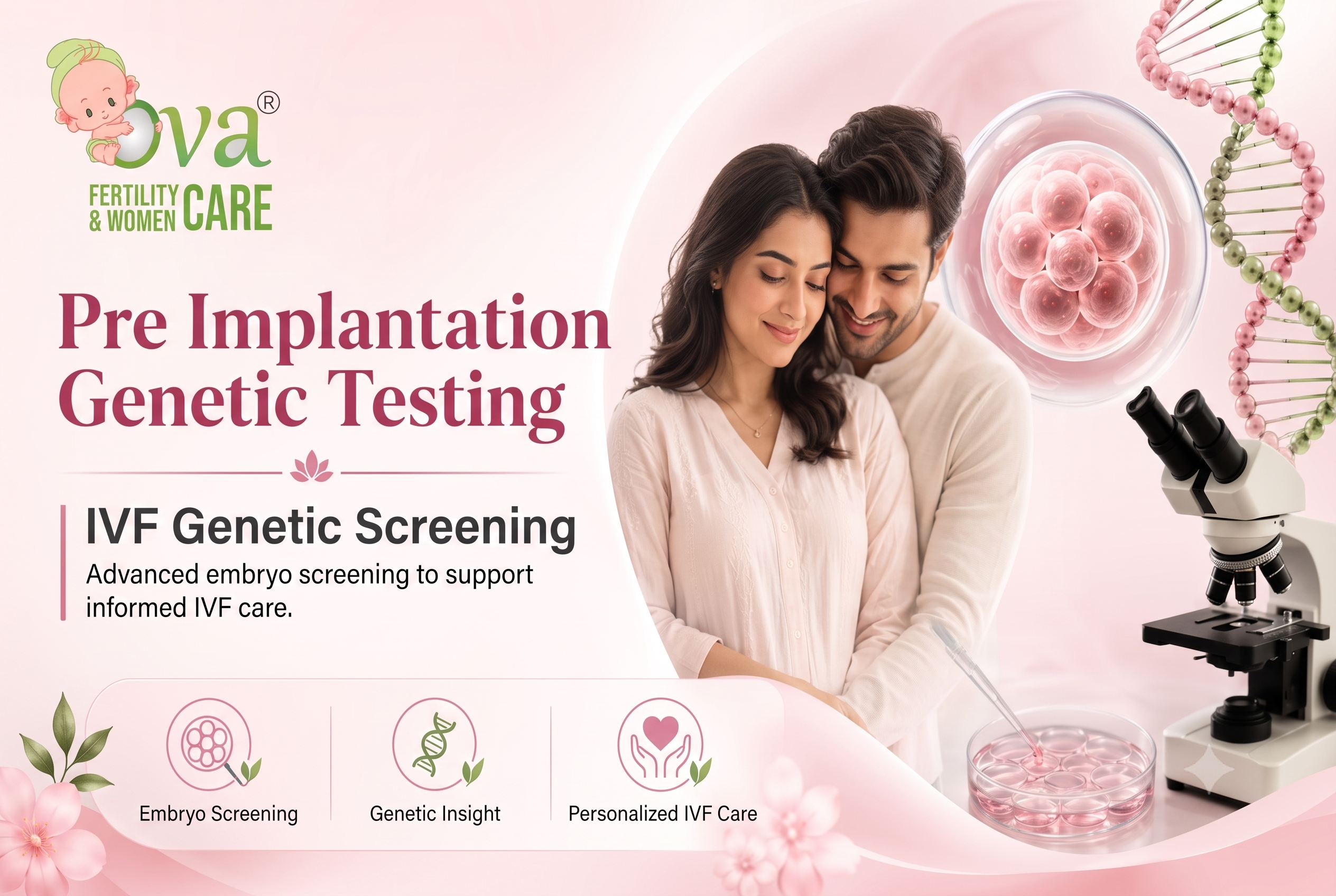
Pre implantation genetic testing is an advanced fertility procedure used during IVF to check embryos for certain genetic or chromosomal abnormalities before embryo transfer. For many couples, IVF is not just a treatment. It is an emotional journey filled with hope, questions, waiting, and sometimes fear of another failed cycle or miscarriage. In such situations, Pre Implantation Genetic Testing, also called PGT, can help doctors select embryos with better genetic potential before placing them in the uterus.
At Ova Fertility and Women Care, fertility treatment is planned with a patient-first approach, where every couple receives proper guidance, counselling, and emotional support during the IVF journey. The clinic provides fertility services such as IVF, IUI, ICSI, male infertility care, blastocyst culture and transfer, egg/sperm/embryo freezing, laser assisted hatching, and Pre-implantation Genetic Testing as part of its fertility care services.
PGT is not needed for every IVF couple. But for selected couples, it can be an important step. It may be suggested when there is a history of repeated miscarriages, failed IVF cycles, advanced maternal age, known genetic disease in the family, or concern about chromosomal abnormalities in embryos.
This blog explains Pre Implantation Genetic Testing in simple words — what it means, how it is done, who may need it, what it can and cannot tell you, and how it fits into the IVF process.
What Is Pre Implantation Genetic Testing?
Pre Implantation Genetic Testing is a laboratory-based test performed on embryos created through IVF. The test is done before embryo transfer. A few cells are carefully taken from an embryo and tested to understand whether the embryo has certain genetic or chromosomal abnormalities.
In simple words, PGT helps doctors study embryos before implantation. The aim is to identify embryos that are more likely to develop normally and support a healthy pregnancy.
Ova Fertility and Women Care describes PGT as an early form of genetic diagnosis carried out on embryos before embryo transfer to check for genetic abnormalities. Embryos found to be genetically normal may then be considered for transfer.
Featured Snippet Answer: What Does Preimplantation Genetic Testing Mean?
Pre Implantation Genetic Testing is an advanced IVF procedure where embryos are screened for certain genetic or chromosomal abnormalities before being transferred to the uterus. It helps fertility specialists select embryos with better genetic potential and may reduce the risk of miscarriage or pregnancy failure in selected couples.
Why Is Pre Implantation Genetic Testing Done?
The main purpose of Pre Implantation Genetic Testing is to support better embryo selection during IVF. In a normal IVF cycle, embryos are usually selected based on growth, appearance, and development stage. With PGT, doctors get additional genetic information about the embryo before transfer.
PGT may help in:
- Reducing the chance of transferring embryos with chromosomal abnormalities
- Lowering the risk of miscarriage in selected cases
- Supporting couples with repeated IVF failures
- Helping couples with known genetic conditions
- Improving embryo selection during IVF
- Avoiding transfer of embryos affected by certain inherited disorders
- Supporting a more informed fertility treatment plan
At Ova Fertility and Women Care, PGT is included among advanced fertility services for couples who may need additional embryo screening during IVF.
How Pre Implantation Genetic Testing Fits Into IVF
PGT is not a separate treatment by itself. It is performed as part of an IVF or ICSI cycle.
To do Pre Implantation Genetic Testing, embryos first need to be created in the IVF laboratory. This usually involves ovarian stimulation, egg collection, sperm preparation, fertilization, embryo culture, embryo biopsy, genetic testing, and then embryo transfer if suitable embryos are available.
Ova Care’s PGT page mentions that the procedure requires egg collection followed by ICSI, where a sperm is injected into the egg to form embryos.
Step-by-Step Process of Pre Implantation Genetic Testing
The exact process may vary depending on the couple’s medical history and fertility plan, but generally, PGT follows these stages.
Step 1: Fertility Consultation and Couple Evaluation
The first step is a detailed consultation with a fertility specialist. The doctor understands the couple’s medical history, previous pregnancies, miscarriage history, IVF history, age, family history, and any known genetic concerns.
The couple may be asked about:
- Previous IVF cycles
- Previous miscarriages
- Genetic disease in the family
- Previous child with a genetic condition
- Male infertility factors
- Age of the female partner
- Egg quality concerns
- Embryo development history
- Any previous abnormal pregnancy reports
This step is important because PGT is not advised randomly. It is suggested when there is a clear medical reason or when it can add useful value to the IVF cycle.
Step 2: Ovarian Stimulation
In an IVF cycle, the female partner receives fertility injections to help the ovaries produce multiple eggs. The growth of follicles is monitored through ultrasound and blood tests.
The aim is to collect mature eggs that can be fertilized in the laboratory.
During this stage, regular monitoring is important. The dose and duration of medicines may differ from patient to patient. Some women may respond quickly, while others may need a more adjusted protocol.
Step 3: Egg Collection
Once the eggs are mature, egg retrieval is planned. This is usually done under medical supervision. The eggs are collected from the ovaries and then taken to the IVF laboratory.
Egg collection is an important step because embryo formation depends on the quality and maturity of eggs, sperm quality, and laboratory conditions.
Step 4: Sperm Collection and ICSI
For PGT cycles, ICSI is commonly used. In ICSI, a single sperm is selected and injected directly into the egg. This helps fertilization and reduces the chance of contamination from extra sperm DNA around the embryo sample.
ICSI is also useful when male infertility factors are present, such as low sperm count, poor motility, or sperm quality concerns.
Ova Fertility and Women Care includes IVF-ICSI and male infertility care in its fertility treatment services.
Step 5: Embryo Culture
After fertilization, embryos are allowed to grow in the IVF lab. They are monitored for development. Many PGT cycles involve testing embryos at the blastocyst stage, which usually means the embryo has developed for a few days after fertilization.
Blastocyst culture helps embryologists observe embryo growth before biopsy and testing. Ova Care also lists blastocyst culture and transfer among its fertility services.
Step 6: Embryo Biopsy
Embryo biopsy is the stage where a few cells are carefully taken from the embryo. This is done by trained embryology professionals in a controlled laboratory setting.
The biopsy sample is sent for genetic testing. The embryo is usually frozen while the test report is awaited.
This step needs skill, precision, and proper lab support. That is why PGT should always be done in a fertility setup with experienced fertility specialists and embryology support.
Step 7: Genetic Testing
The collected cells are tested to look for specific genetic or chromosomal conditions, depending on the type of PGT advised.
The test may check whether the embryo has the expected number of chromosomes, whether a known inherited condition is present, or whether there are specific structural chromosome concerns.
The result helps the fertility team understand which embryo may be more suitable for transfer.
Step 8: Embryo Transfer Planning
Once the report is available, the fertility specialist discusses the result with the couple. If suitable embryos are available, embryo transfer is planned in a later cycle or as advised by the doctor.
The uterus is prepared for transfer, and the selected embryo is placed inside the uterus.
Even after PGT, pregnancy is not guaranteed. But in selected cases, it can improve decision-making and reduce the chance of transferring embryos with known abnormalities.
Types of Pre Implantation Genetic Testing
There are different types of PGT. The type recommended depends on the couple’s history and the reason for testing.
1. PGT-A: Testing for Chromosome Number Abnormalities
PGT-A stands for Pre Implantation Genetic Testing for Aneuploidy. It checks whether the embryo has the correct number of chromosomes.
A normal human embryo should usually have 46 chromosomes. Sometimes, embryos may have missing or extra chromosomes. Such embryos may fail to implant, lead to miscarriage, or result in chromosomal conditions.
PGT-A may be considered in cases such as:
- Advanced maternal age
- Repeated IVF failure
- Recurrent miscarriage
- Previous pregnancy with chromosomal abnormality
- Multiple failed embryo transfers
- Poor embryo development history
PGT-A does not check for every disease. It mainly checks chromosome number.
2. PGT-M: Testing for Single Gene Disorders
PGT-M is used when there is a known single gene disorder in the family. This may be advised if one or both partners carry a genetic condition that can be passed to the child.
PGT-M may be considered when there is a known risk of conditions such as inherited blood disorders, certain metabolic disorders, or other single gene conditions.
This type of testing needs detailed planning. The couple may need genetic counselling before starting IVF so that the test can be designed properly.
3. PGT-SR: Testing for Structural Chromosome Rearrangements
PGT-SR is used when one partner has a structural chromosome rearrangement, such as a translocation or inversion.
People with balanced translocations may be healthy themselves but may produce embryos with unbalanced chromosomes. This can increase the risk of miscarriage or abnormal pregnancy.
PGT-SR helps identify embryos with a more balanced chromosomal pattern before transfer.
Who Should Consider Pre Implantation Genetic Testing?
Not every couple undergoing IVF needs Pre Implantation Genetic Testing. A fertility specialist may suggest PGT when there is a medical reason or repeated reproductive difficulty.
PGT may be considered for:
- Couples with repeated miscarriages
- Couples with repeated IVF failures
- Women of advanced maternal age
- Couples with known genetic disease in the family
- Couples who are carriers of inherited disorders
- Couples with previous child affected by a genetic condition
- Couples with previous abnormal pregnancy reports
- Couples with chromosomal rearrangements
- Couples with poor embryo history in IVF
- Some cases of severe male infertility
The decision should always be made after consultation, counselling, and proper understanding of benefits and limitations.
Pre Implantation Genetic Testing and Repeated Miscarriage
Repeated miscarriage can be emotionally very painful. Many couples go through repeated pregnancy loss without understanding why it is happening.
One possible reason for miscarriage is chromosomal abnormality in the embryo. If an embryo has extra or missing chromosomes, it may not develop properly, and pregnancy may stop naturally.
In selected cases, PGT can help identify embryos with better chromosomal potential before transfer. This may reduce the chance of miscarriage related to embryo chromosome problems.
However, miscarriage can also happen due to other reasons such as uterine problems, hormonal issues, clotting concerns, thyroid imbalance, immune-related factors, infection, or other medical conditions. So, PGT is one part of evaluation, not the only answer.
Pre Implantation Genetic Testing and Failed IVF Cycles
A failed IVF cycle can be difficult to accept, especially when everything seemed to go well. Sometimes embryos look good under the microscope but may still have chromosomal abnormalities.
PGT may help in selected cases where:
- Multiple embryos were transferred but pregnancy did not happen
- Good-looking embryos failed to implant
- There were repeated IVF failures
- There is concern about embryo genetic health
- Age-related embryo abnormality risk is higher
At Ova Fertility and Women Care, IVF care includes counselling and emotional support during the IVF journey, helping couples understand the treatment process and cope with concerns in a confidential environment.
Pre Implantation Genetic Testing and Advanced Maternal Age
As a woman’s age increases, the chance of chromosomal abnormalities in embryos may increase. This can affect implantation, miscarriage risk, and pregnancy outcome.
Women above 35 may sometimes be advised to consider PGT-A, especially if there is a history of miscarriage, failed IVF, or fewer good embryos.
Still, age alone does not automatically mean every woman must do PGT. The decision depends on ovarian reserve, embryo number, previous history, and medical advice.
Pre Implantation Genetic Testing and Genetic Disease Risk
Some couples know that a genetic condition runs in the family. Sometimes, both partners may be carriers of a condition but may not have symptoms themselves. In such cases, there may be a risk of passing the condition to the child.
PGT-M can help screen embryos for a known genetic disorder before transfer.
This can be especially useful when:
- A previous child has a genetic disorder
- One or both partners are known carriers
- Family history shows inherited disease
- Genetic testing before IVF identifies risk
- The couple wants to reduce the chance of passing a serious condition
Genetic counselling is very important in such cases. Couples should understand what the test can detect, what it cannot detect, and what further pregnancy testing may still be needed.
Benefits of Pre Implantation Genetic Testing
PGT can be useful for selected couples when done for the right indication.
Possible benefits include:
- Better embryo selection during IVF
- Reduced risk of transferring embryos with known abnormalities
- Lower chance of miscarriage in selected cases
- Helpful for couples with inherited disease risk
- Useful after repeated IVF failure
- May reduce emotional burden of repeated unsuccessful transfers
- Supports more informed embryo transfer decisions
- Helps in planning frozen embryo transfer with more clarity
PGT does not make IVF easy emotionally, but it may add useful information for couples who have already faced repeated difficulty.
Limitations of Pre Implantation Genetic Testing
It is important to understand that PGT is not a guarantee of pregnancy or a healthy baby. It is a testing method used during IVF to help assess embryos before selection.
Ova Care clearly mentions that Pre-implantation Genetic Testing is not 100% accurate, cannot detect all abnormalities or birth defects, and does not guarantee a healthy live pregnancy.
Important limitations include:
- PGT cannot guarantee pregnancy
- PGT cannot guarantee live birth
- PGT cannot detect every genetic condition
- Some embryos may show mosaic results
- Testing may not be possible if embryos do not develop well
- A normal PGT result does not remove the need for pregnancy monitoring
- Prenatal screening or testing may still be advised during pregnancy
- Not every IVF couple benefits from PGT
This is why proper counselling before PGT is very important.
What Are Mosaic Embryos?
Mosaic embryos are embryos where some cells appear normal and some cells appear abnormal. This can make interpretation more complex.
A mosaic result does not always give a simple “yes” or “no” answer. The fertility specialist and genetic counsellor may explain what the result means and whether transfer can be considered depending on the situation.
This is one reason why PGT reports should always be discussed carefully instead of trying to understand them alone.
Does Pre Implantation Genetic Testing Improve IVF Success?
PGT may improve embryo selection in selected patients, especially when embryo chromosome abnormalities are a likely reason for repeated failure or miscarriage. It can help avoid transfer of embryos with known abnormalities.
However, IVF success depends on many factors, including:
- Age of the female partner
- Egg quality
- Sperm quality
- Embryo development
- Uterine lining
- Hormonal health
- Previous fertility history
- Lab quality
- Transfer technique
- Overall health
So, PGT may support IVF planning, but it is not a magic solution for every case.
Is PGT Painful?
The genetic testing is done on the embryo in the lab, not directly on the woman’s body. The woman goes through the usual IVF steps such as injections, monitoring, egg retrieval, and embryo transfer planning.
Embryo biopsy is performed in the laboratory. The patient does not feel the biopsy because it is done on the embryo outside the body.
Some women may feel discomfort during IVF injections or after egg retrieval, but the PGT part itself is a laboratory process.
Is Pre Implantation Genetic Testing Safe?
PGT is widely used in advanced IVF care, but it should be done only when needed and in the right fertility setup. The embryo biopsy needs skill and careful lab handling.
The fertility specialist will explain whether the benefit is meaningful in your case. For some couples, PGT may be very helpful. For others, it may not be necessary.
PGT and Frozen Embryo Transfer
In many PGT cycles, embryos are frozen after biopsy while the genetic report is awaited. Once the report is available, a frozen embryo transfer may be planned in a later cycle.
This allows time for:
- Genetic report review
- Uterine preparation
- Hormonal planning
- Better timing of transfer
- Couple counselling
Frozen embryo transfer is commonly used in IVF planning and may be advised depending on the treatment protocol.
Emotional Side of PGT and IVF
Pre Implantation Genetic Testing can feel reassuring for some couples, but it can also bring anxiety. Waiting for embryo results is not easy. Some couples may worry about whether embryos will be normal, whether transfer will happen, or what the report means.
This emotional side matters.
At Ova Fertility and Women Care, the IVF journey includes emotional support, counselling, and a confidential environment where couples can discuss concerns and feelings openly.
Couples should never feel that they have to understand everything alone. Asking questions is part of the process.
Questions to Ask Your Fertility Specialist Before PGT
Before deciding on Pre Implantation Genetic Testing, you can ask:
- Do we really need PGT in our case?
- Which type of PGT is recommended for us?
- What problem are we trying to detect?
- How many embryos may be suitable for testing?
- What happens if no embryo is genetically suitable?
- Can PGT increase our chance of pregnancy?
- What are the limitations of the test?
- Will prenatal testing still be needed after pregnancy?
- What will happen to embryos after biopsy?
- How should we understand mosaic embryo results?
- What will be the next step after the report?
A clear discussion helps reduce confusion and anxiety.
People Also Ask: Is Pre Implantation Genetic Testing Necessary for Every IVF Cycle?
No, Pre Implantation Genetic Testing is not necessary for every IVF cycle. It is usually recommended for selected couples based on age, miscarriage history, failed IVF cycles, genetic disease risk, chromosomal concerns, or previous abnormal pregnancy history.
People Also Ask: Can PGT Prevent Miscarriage?
PGT may reduce the risk of miscarriage related to chromosomal abnormalities in selected cases. However, miscarriage can happen due to many reasons, so PGT cannot prevent all miscarriages.
People Also Ask: Can PGT Detect All Birth Defects?
No. PGT cannot detect all birth defects or all health conditions. It checks for specific genetic or chromosomal abnormalities depending on the type of test. Pregnancy monitoring and prenatal screening may still be advised.
People Also Ask: Does PGT Guarantee Pregnancy?
No. PGT does not guarantee pregnancy. It helps with embryo selection, but IVF success also depends on egg quality, sperm quality, uterus health, embryo implantation, hormonal balance, and other medical factors.
People Also Ask: What Happens If All Embryos Are Abnormal?
If all tested embryos show abnormal results, embryo transfer may not be advised. The fertility specialist will discuss possible next steps, which may include another IVF cycle, further evaluation, donor options in selected cases, or other individualized treatment planning.
Why Choose Ova Fertility and Women Care for PGT Guidance?
Ova Fertility and Women Care offers fertility, maternity, gynecology, endoscopy, ultrasound, and oncofertility services, with a focus on women’s health and motherhood care. Its fertility services include IVF, IUI, ICSI, male infertility, Pre-implantation Genetic Testing, blastocyst culture and transfer, laser assisted hatching, embryo freezing, and related advanced fertility treatments.
For couples considering PGT, this integrated fertility setup matters because genetic testing is only one part of the IVF journey. The couple also needs proper consultation, ovarian stimulation, embryo development, lab coordination, counselling, and transfer planning.
Ova Care supports couples with:
- Fertility consultation
- IVF and ICSI treatment
- Pre Implantation Genetic Testing guidance
- Embryo culture and transfer planning
- Blastocyst culture support
- Male infertility evaluation
- Egg, sperm, and embryo freezing
- Emotional support during IVF
- Confidential counselling
- Personalized fertility planning
The goal is not just to perform a test. The goal is to guide couples with clarity, honesty, and support throughout the fertility journey.
Conclusion
Pre Implantation Genetic Testing is an advanced IVF genetic screening method that helps fertility specialists check embryos for certain genetic or chromosomal abnormalities before embryo transfer. For selected couples, especially those with repeated miscarriages, failed IVF cycles, advanced maternal age, or known genetic disease risk, PGT can provide valuable information during IVF planning.
But it is important to understand PGT correctly. It does not guarantee pregnancy. It does not detect every health condition. It does not replace pregnancy monitoring. What it does offer is better genetic insight into embryos before transfer, which can help doctors and couples make more informed decisions.
At Ova Fertility and Women Care, couples can receive guidance for IVF, ICSI, Pre Implantation Genetic Testing, embryo transfer planning, and fertility counselling in a supportive and confidential environment. For couples who have faced uncertainty in their fertility journey, the right information and the right care can make the next step feel clearer.