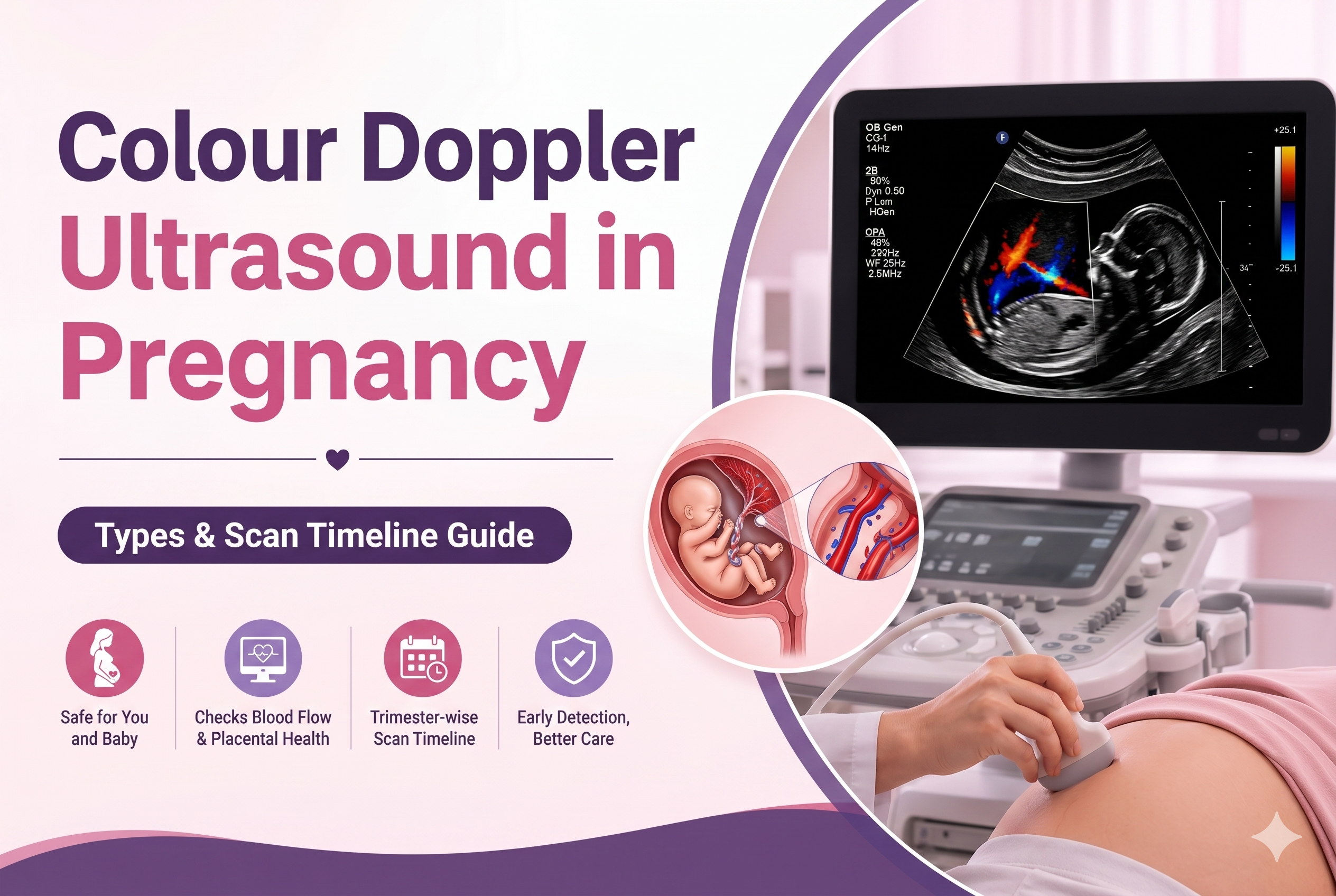


Pregnancy is a journey where every small update about the baby matters. From the first heartbeat to steady growth, doctors rely on imaging to understand what’s happening inside the womb. One of the most important and slightly advanced scans used during this time is the colour doppler ultrasound in pregnancy.
Unlike a basic ultrasound that shows images, this scan goes a step further. It helps doctors study blood flow between the mother, placenta, and baby, which gives deeper insight into the baby’s well-being.
If you’re confused about when it’s done, why it’s recommended, or how it fits into your pregnancy timeline – this guide will walk you through everything in a simple, easy-to-understand way.
What is Colour Doppler Ultrasound in Pregnancy?
Colour Doppler ultrasound is a specialized type of ultrasound scan that tracks blood flow using sound waves. It visually displays the movement of blood in different colors (usually red and blue), helping doctors understand how well circulation is happening in key areas.
In pregnancy, it mainly checks:
- Blood flow in the umbilical cord
- Circulation in the placenta
- Blood supply to the baby’s brain and organs
- Uterine blood flow in the mother
This scan is not done for every pregnancy routinely, but it becomes very important in high-risk cases or when doctors need more detailed information.
Why is Colour Doppler Ultrasound Important?
A normal ultrasound shows structure.
A Doppler ultrasound shows function.
That difference matters.
Here’s why this scan is often recommended:
1. To Check Placental Function
The placenta is the baby’s lifeline. Doppler helps ensure that oxygen and nutrients are reaching the baby properly.
2. To Monitor Baby’s Growth
If the baby appears smaller than expected, Doppler helps determine whether restricted blood flow is affecting growth.
3. To Detect Complications Early
Conditions like:
- Intrauterine Growth Restriction (IUGR)
- Placental insufficiency
can be identified earlier with Doppler scans.
4. To Assess High-Risk Pregnancies
Doctors may recommend it if:
- The mother has high blood pressure or diabetes
- There’s a history of pregnancy complications
- Multiple pregnancies (twins/triplets) are involved
Types of Ultrasound in Pregnancy
Understanding where Doppler fits in becomes easier when you know the different types of ultrasound scans done during pregnancy.
1. Standard (2D) Ultrasound
- Basic scan used throughout pregnancy
- Shows baby’s shape and position
2. 3D/4D Ultrasound
- Provides more detailed images
- Mostly used for visual clarity, not always medically necessary
3. Transvaginal Ultrasound
- Done in early pregnancy
- Helps detect pregnancy and heartbeat
4. Colour Doppler Ultrasound
- Focuses on blood flow and circulation
- Used when deeper analysis is needed
Pregnancy Scan Timeline (Trimester-wise Guide)
Pregnancy is divided into three trimesters, and each stage has its own important scans. Let’s break it down clearly.
First Trimester Scans (0–12 Weeks)
This stage is all about confirming and establishing the pregnancy.
Key Scans:
- Early Pregnancy Scan (6–8 weeks)
Confirms pregnancy, heartbeat, and location - NT Scan (11–13 weeks)
Screens for chromosomal abnormalities
Is Doppler Used Here?
Usually, colour doppler ultrasound in pregnancy is not required in the first trimester, unless there is a specific concern like abnormal bleeding or suspected complications.
Second Trimester Scans (13–28 Weeks)
This is the most detailed stage for fetal development.
Key Scans:
- Anomaly Scan (18–22 weeks)
Examines baby’s organs, spine, brain, and heart
Role of Doppler in This Stage
Doppler may be used if:
- Baby’s growth seems slower
- Placental position or function needs evaluation
It helps doctors understand whether the baby is receiving adequate blood supply.
Third Trimester Scans (28 Weeks to Birth)
This stage focuses on monitoring growth and preparing for delivery.
Key Scans:
- Growth scans
- Position and amniotic fluid level checks
Where Doppler Becomes Crucial
This is where colour doppler ultrasound in pregnancy becomes most important.
Doctors use it to:
- Check umbilical artery blood flow
- Monitor baby’s oxygen supply
- Decide if early delivery might be needed
When is Colour Doppler Ultrasound Recommended?
Not every pregnancy needs it, but doctors suggest it in specific situations:
- Baby is not growing as expected
- Reduced fetal movements
- High blood pressure in mother
- Diabetes during pregnancy
- Previous pregnancy complications
- Twin or multiple pregnancies
It’s a decision-based scan, not a routine one.
Is Colour Doppler Ultrasound Safe?
Yes, it is considered safe when done under medical guidance.
It uses sound waves, not radiation, similar to standard ultrasounds. Doctors ensure that:
- Exposure time is limited
- It is only done when medically necessary
So there’s no need to worry when your doctor recommends it.
What Happens During the Scan?
The process is simple and similar to a regular ultrasound.
- You lie down comfortably
- A gel is applied to your abdomen
- A handheld device (transducer) is moved over your belly
- The machine displays images and blood flow patterns
The scan usually takes 20–30 minutes, depending on the case.
How to Prepare for a Doppler Scan
Preparation is minimal:
- Wear comfortable clothing
- Stay relaxed
- Follow any instructions given by your doctor
In most cases, no fasting or special preparation is required.
Understanding Doppler Results
You might hear terms like:
- Umbilical artery flow
- Resistance index
- Placental circulation
Don’t worry – your doctor will interpret these.
In simple words, the results tell: Whether blood is flowing smoothly Whether the baby is getting enough oxygen
How This Scan Helps in Decision-Making
This is where Doppler becomes powerful.
Based on results, doctors can:
- Continue pregnancy monitoring
- Increase scan frequency
- Plan early delivery if needed
It helps avoid complications by acting at the right time.
Common Myths About Doppler Ultrasound
Myth 1: It’s harmful to the baby
Fact: It’s safe when used appropriately
Myth 2: It’s needed in every pregnancy
Fact: Only recommended when required
Myth 3: It replaces all other scans
Fact: It complements other ultrasounds, not replaces them
When Should You Talk to Your Doctor?
You should ask about Doppler if:
- You feel reduced baby movements
- You’ve been told the baby is small
- You have a high-risk pregnancy
Getting clarity early helps avoid stress later.
A Note on Choosing the Right Care
Scans are only as good as the expertise behind them. Proper interpretation matters more than the scan itself.
If you’re looking for a detailed understanding of pregnancy scans and expert guidance, you can explore this page for more information:
https://theovacare.com/ultrasound-in-pregnancy/
It gives a broader view of how ultrasound is used across different stages of pregnancy.
Final Thoughts
The colour doppler ultrasound in pregnancy is not just another scan – it’s a deeper check into your baby’s health. It provides answers when basic scans are not enough.
Think of it as a safety layer that helps doctors:
- Monitor blood flow
- Detect risks early
- Make better decisions for you and your baby
When used at the right time, it can make a significant difference in ensuring a safe and healthy pregnancy journey.
For a complete overview of pregnancy scans and timelines, you can also refer to this detailed guide:
https://theovacare.com/ultrasound-in-pregnancy/