




The ideal follicle size for egg retrieval is not one fixed number.
During IVF, fertility specialists usually look at the size of several developing follicles rather than waiting for every follicle to reach exactly the same measurement. Updated ESHRE guidance says final egg maturation is often triggered when several leading follicles measure approximately 16–22 mm, but trigger timing should be decided individually.
So if your scan shows follicles measuring 14 mm, 17 mm, 19 mm and 21 mm, it does not automatically mean that some are “good” and others are “bad.”
The entire follicle group matters.
What Does Follicle Size Mean in IVF?
A follicle is a fluid-filled structure in the ovary that may contain an egg.
During IVF stimulation, fertility medicines encourage several follicles to develop.
Doctors use ultrasound to measure these follicles in millimetres.
The measurement helps estimate how far follicular development has progressed, but ultrasound cannot directly show:
- whether a follicle contains an egg
- whether that egg is mature
- whether it will fertilise
- whether it will develop into an embryo
This is why follicle size is a guide rather than a guarantee.
What Is Considered a Mature Follicle Size in IVF?
There is no universal measurement at which every follicle contains a mature egg.
ESHRE’s 2025 ovarian stimulation guideline states that trigger timing is multifactorial and that final maturation is commonly triggered when several leading follicles are around 16–22 mm.
Research has also shown that follicles in a wider range can contribute mature eggs. One study found that follicles measuring approximately 12–19 mm on trigger day contributed most to the number of mature eggs retrieved in the studied cycles.
These findings should not be turned into a DIY trigger chart.
Your doctor has to interpret your individual scan.
How to Read Follicle Measurements
A simple way to understand the numbers is:
Follicle Measurement | General Meaning |
Under 10 mm | Usually still small |
10–13 mm | Developing follicle |
14–15 mm | Intermediate size |
16–18 mm | May be approaching maturity |
18–22 mm | Commonly seen among leading follicles around trigger planning |
Above 22 mm | Can still contain an egg; larger does not automatically mean better |
These ranges are educational only.
Egg maturity is confirmed in the laboratory after retrieval.
Why Are Follicles Different Sizes?
Uneven follicle growth is common during IVF.
For example, one scan may show:
- 20 mm
- 18 mm
- 17 mm
- 15 mm
- 13 mm
Follicles do not all respond to stimulation at exactly the same speed.
The doctor has to balance two things:
- giving smaller follicles enough time to continue developing
- avoiding unnecessary delay for the leading follicles
This is one reason doctors look at the follicle cohort, meaning the group of developing follicles, rather than a single measurement.
How Does IVF Follicle Monitoring Work?
IVF follicle monitoring usually involves transvaginal ultrasound scans during ovarian stimulation.
Your specialist may assess:
- number of follicles
- follicle sizes
- pattern of growth
- ovarian response
- treatment duration
- readiness for the trigger
Hormone testing may also be used depending on the patient’s protocol, although ESHRE does not recommend using oestradiol alone to decide trigger timing.
Monitoring allows treatment decisions to respond to what your ovaries are actually doing.
What Is the Follicle Size Before Trigger?
Patients often expect the trigger injection to happen when the largest follicle reaches 18 mm.
In practice, the decision is more detailed.
ESHRE says the timing can take into account:
- size of the growing follicle group
- hormonal information when relevant
- stimulation duration
- embryo-transfer strategy
- previous cycle experience
- individual treatment considerations
This means two patients with a 19 mm leading follicle may receive their trigger on different days.
Can a 14 or 15 mm Follicle Contain a Mature Egg?
Yes, it is possible.
Smaller follicles may sometimes produce mature oocytes, although the likelihood generally changes with follicle size.
The 2018 study examining follicles on trigger day found that follicles between about 12 and 19 mm made an important contribution to mature oocyte yield.
That does not mean every 14 mm follicle will contain a mature egg.
It simply means smaller follicles should not automatically be described as useless.
Is an 18–20 mm Follicle Guaranteed to Have a Mature Egg?
No.
A follicle measuring 18 mm, 20 mm or even larger may contain a mature egg, but size cannot guarantee it.
Likewise:
one follicle does not equal one egg.
During egg collection, some follicles may not yield an egg at all. NHS fertility guidance specifically notes that not every follicle contains an egg.
The final result is only known after the laboratory examines the retrieved material.
Does Bigger Follicle Size Mean Better Egg Quality?
No.
Follicle size and egg quality are not the same thing.
A suitable follicle measurement may increase the likelihood of retrieving a mature egg, but it cannot predict whether that egg will:
- fertilise
- form a blastocyst
- implant
- result in pregnancy
Age and other biological factors also influence reproductive potential.
Do not use ultrasound numbers to predict how many embryos you will have.
Your fertility specialist should interpret your follicle measurements throughout IVF.
Speak to the clinic if:
- you are unclear about your trigger timing
- you accidentally took your trigger at the wrong time
- you missed or changed a fertility medicine
- you develop severe abdominal pain
- abdominal swelling becomes marked
- you have repeated vomiting
- you notice difficulty breathing or reduced urination
Do not change medication because you think your follicles are growing too slowly or quickly.
Final Thoughts
The best way to understand follicle size for egg retrieval is to stop looking for one perfect number.
Your fertility doctor evaluates the whole group of follicles, their growth pattern and your response to stimulation before choosing the trigger time.
Ova Fertility & Women Care provides ovarian monitoring as part of its IVF treatment in Thane, along with IVF, ICSI and related fertility services. If your scan numbers are worrying you, ask your fertility specialist to explain what the complete follicle pattern means for your cycle.
FAQ
1. What is the ideal follicle size for egg retrieval?
There is no single ideal size. ESHRE says several leading follicles are commonly around 16–22 mm when final oocyte maturation is triggered, but the timing should be individualised.
2. Is an 18 mm follicle mature?
An 18 mm follicle is within a size range often seen near trigger timing and may contain a mature egg. Ultrasound cannot confirm egg maturity, so the laboratory provides the final answer after retrieval.
3. Can a 15 mm follicle give a mature egg?
Yes, it can. Research shows follicles smaller than the commonly quoted 18 mm mark can contribute mature eggs, although not every follicle will do so.
4. Do all follicles give one egg each?
No. Not every follicle contains a retrievable egg, and some retrieved eggs may be immature.
5. Can I delay my trigger to allow small follicles to grow?
Do not change trigger timing yourself. Delaying or advancing the injection can affect egg maturation and retrieval timing. Follow the exact schedule given by your fertility clinic.
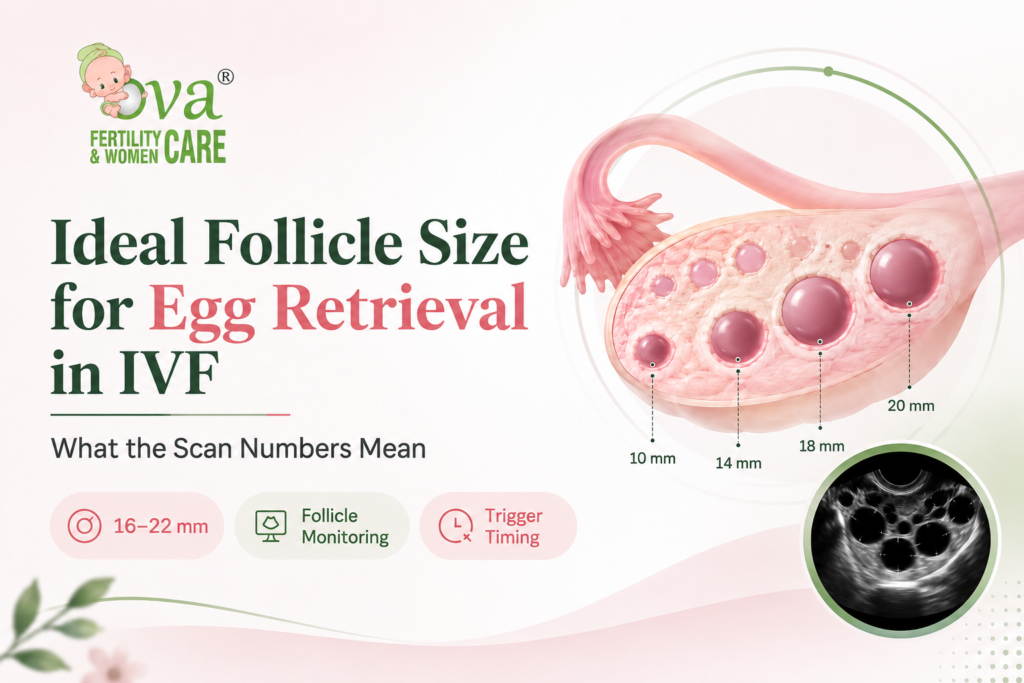
Table Of Content
- What Does Follicle Size Mean in IVF?
- What Is Considered a Mature Follicle Size in IVF?
- How to Read Follicle Measurements
- Why Are Follicles Different Sizes?
- What Is the Follicle Size Before Trigger?
- Can a 14 or 15 mm Follicle Contain a Mature Egg?
- Is an 18–20 mm Follicle Guaranteed to Have a Mature Egg?
- Does Bigger Follicle Size Mean Better Egg Quality?
- When Should You Consult a Doctor?
- Final Thoughts
- FAQ
