




How many eggs are good for IVF? There is no single number that can be called ideal for every patient.
Some research has found favourable fresh-cycle outcomes in moderate egg-yield groups. A recent individual-patient meta-analysis involving a specific stimulation medicine found the highest fresh-cycle live birth rates among patients with around 8–14 retrieved eggs in that dataset. But this does not mean every patient should aim for 8–14 eggs or that fewer eggs mean IVF cannot work.
Age, ovarian reserve, egg maturity, fertilisation and embryo development all affect what an egg count means.
Your egg number should therefore be compared with your expected ovarian response, not someone else’s IVF cycle.
Retrieved Eggs and Mature Eggs Are Different
After egg retrieval, the embryology laboratory examines the collected eggs.
Some may be mature and some may not yet have reached the stage needed for the planned fertilisation procedure.
This gives us an important distinction:
Total eggs retrieved ≠ mature eggs.
For example:
- 10 eggs may be retrieved
- 8 may be mature
- 6 may fertilise
- 2 or 3 may continue to the blastocyst stage
Those numbers are only an example, not a predicted IVF conversion rate.
Every cycle is different.
Why Egg Numbers Drop During IVF
IVF involves several biological stages:
Follicles on scan
↓
Eggs retrieved
↓
Mature eggs
↓
Fertilised eggs
↓
Developing embryos
↓
Embryos suitable for transfer or freezing
Not every follicle contains an egg.
Not every retrieved egg will be mature.
Not every mature egg will fertilise or continue developing.
Because of this natural attrition, a good egg retrieval count cannot be judged from the first number alone.
Is 10 Eggs Good for IVF?
Ten eggs may represent a useful response for many patients, and this number falls within ranges associated with favourable fresh-cycle outcomes in some studies.
But 10 eggs does not guarantee:
- 10 mature eggs
- 10 fertilised eggs
- 10 embryos
- pregnancy
A patient with six retrieved eggs and several mature eggs may have a very different laboratory outcome from someone with 15 retrieved eggs.
Are 5 Eggs Enough for IVF?
Five eggs can be enough for an IVF cycle to progress.
The next questions matter more:
- How many are mature?
- How many fertilise normally?
- How do the embryos develop?
- Is this number consistent with the patient’s ovarian reserve?
A patient with lower ovarian reserve may be expected to produce fewer eggs than a younger patient with a high antral follicle count.
This is why calling five eggs “good” or “bad” without context is not useful.
What If Only 1–3 Eggs Are Retrieved?
Retrieving one to three eggs means there are fewer opportunities for fertilisation and embryo development, but it does not automatically mean that the cycle has failed.
A lower egg yield may be seen with:
- diminished ovarian reserve
- increasing reproductive age
- lower antral follicle count
- lower response to stimulation
- previous ovarian surgery
- individual biological variation
If fewer eggs are retrieved than expected, the fertility specialist may review the response before deciding whether any changes should be considered in a future cycle.
Is More Always Better?
More eggs can provide more opportunities to produce embryos, particularly when suitable embryos can be frozen for future transfer.
But extremely high ovarian response is not the goal.
The same recent meta-analysis that reported favourable fresh outcomes with 8–14 eggs also found a higher rate of OHSS among those retrieving 15 or more eggs in that study population.
So the goal of stimulation is not:
“Get the maximum possible number of eggs.”
The goal is a safe and appropriate response for that patient.
Age Changes the Meaning of IVF Egg Number
Age is a major reason egg-count comparisons between patients can be misleading.
ASRM explains that ovarian reserve refers mainly to oocyte quantity, while ovarian reserve tests are much weaker predictors of reproductive potential independently of age.
This means 10 retrieved eggs in two patients of different ages should not automatically be interpreted in the same way.
Age can influence egg competence and embryo development even when the retrieval numbers are similar.
Does AMH Predict How Many Eggs You Will Get?
AMH, or Anti-Müllerian Hormone, is commonly used to estimate ovarian reserve.
It can help fertility specialists predict how strongly someone may respond to ovarian stimulation.
ASRM states that ovarian reserve markers can help predict oocyte yield after controlled ovarian stimulation, but they are poor standalone predictors of reproductive potential.
So AMH may help answer:
“How might my ovaries respond?”
It cannot reliably answer:
“Will IVF work?”
Egg Quantity Is Not Egg Quality
A high egg number does not automatically mean high egg quality.
Similarly, retrieving fewer eggs does not mean every egg is poor quality.
Ovarian reserve and egg quality are different concepts. ASRM specifically separates oocyte quantity from oocyte quality and reproductive potential.
The embryology laboratory learns more as the cycle progresses through:
- maturity assessment
- fertilisation
- embryo division
- blastocyst development
That information is more useful than treating the retrieval number as a final result.
Why Comparing IVF Cycles Creates Unnecessary Stress
Someone online may say:
“I retrieved 18 eggs.”
That number tells you almost nothing about your own cycle.
You may not know their:
- age
- AMH
- fertility diagnosis
- stimulation protocol
- mature egg number
- fertilisation outcome
- embryo development
Even two cycles in the same person can produce different results.
A better comparison is:
What did my doctor expect based on my ovarian reserve, and how did my ovaries actually respond?
Questions to Ask After Egg Retrieval
Instead of focusing only on the total number, ask your fertility team:
- How many eggs were mature?
- How many fertilised normally?
- How are the embryos developing?
- Was my response close to what you expected?
- Does anything from this cycle change future treatment planning?
These questions provide far more useful information than comparing egg counts.
When Should You Consult a Doctor?
Egg numbers themselves are not usually a reason for emergency medical attention.
The more immediate concern after retrieval is how you are physically recovering.
Contact your fertility clinic if you develop:
- severe abdominal pain
- rapidly increasing abdominal swelling
- repeated vomiting
- difficulty drinking fluids
- reduced urination
- difficulty breathing
- heavy bleeding
- severe weakness or fainting
These symptoms can require assessment for OHSS or another post-retrieval complication.
Final Thoughts
There is no single answer to how many eggs are good for IVF.
The number retrieved matters, but it should be understood as the first laboratory result rather than the final measure of a cycle.
A more useful picture is:
Retrieved eggs → mature eggs → fertilisation → embryo development.
If you are considering IVF treatment in Thane, Ova Fertility & Women Care provides fertility assessment, IVF, ICSI and related reproductive services. Your fertility specialist can explain what your expected and actual egg numbers mean based on your age, ovarian reserve and treatment response.
FAQ
1. How many eggs are good for IVF?
There is no ideal number for everyone. Some research has found favourable fresh-cycle outcomes with moderate egg yields, but age, ovarian reserve, maturity and embryo development determine what the number means for an individual patient.
2. Are 5 eggs enough for IVF?
Five eggs may be enough for IVF to progress. The key questions are how many are mature, how many fertilise and how any resulting embryos develop.
3. Is 10 eggs a good egg retrieval count?
Ten eggs can represent a useful ovarian response for many patients. It does not guarantee a particular number of embryos or a pregnancy.
4. Does high AMH mean I will get many good-quality eggs?
Not necessarily. AMH can help estimate ovarian response and egg quantity, but it does not directly measure egg quality or guarantee IVF success.
5. Are mature eggs more important than total eggs retrieved?
The mature egg count provides more useful information for the fertilisation stage because not every retrieved egg will be mature. Even then, maturity is only one step; fertilisation and embryo development still need to occur.
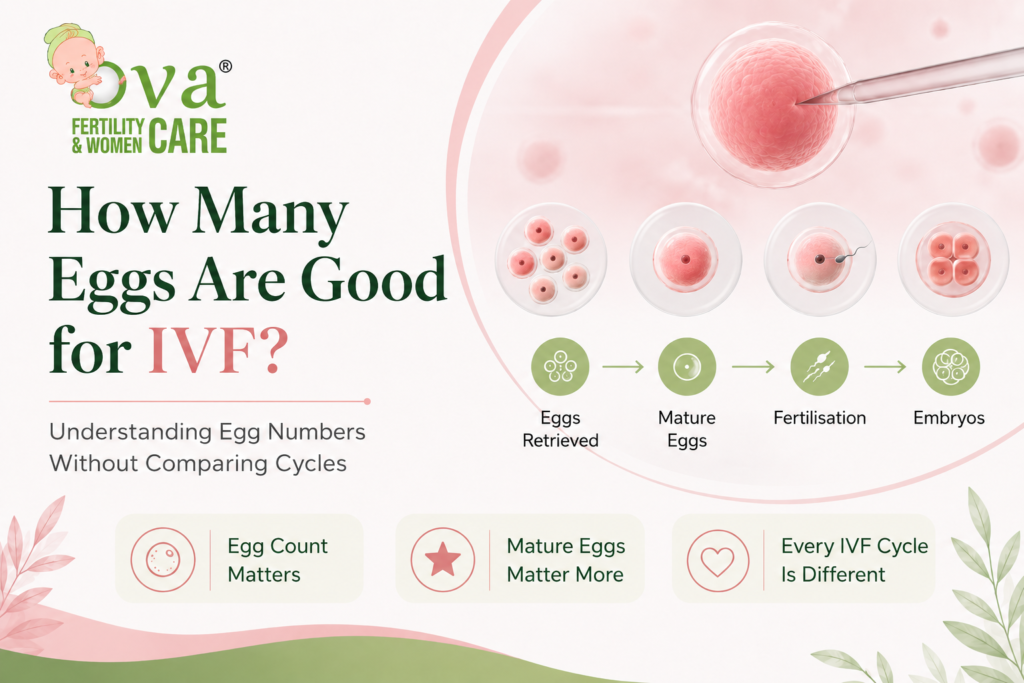
Table Of Content
- Retrieved Eggs and Mature Eggs Are Different
- Why Egg Numbers Drop During IVF
- Is 10 Eggs Good for IVF?
- Are 5 Eggs Enough for IVF?
- What If Only 1–3 Eggs Are Retrieved?
- Is More Always Better?
- Age Changes the Meaning of IVF Egg Number
- Egg Quantity Is Not Egg Quality
- Why Comparing IVF Cycles Creates Unnecessary Stress
- Questions to Ask After Egg Retrieval
- When Should You Consult a Doctor?
- Final Thoughts
- FAQ
