




When pregnancy is taking longer than expected, fertility testing should not focus only on the woman. Conception depends on reproductive factors in both partners, which is why a fertility checkup for couples usually evaluates the woman and man together.
A fertility checkup does not mean that every couple needs a long list of tests or advanced treatment. The first goal is to understand whether ovulation is occurring, whether the uterus and fallopian tubes appear suitable, whether sperm parameters are within an expected range, and whether there are medical factors that could be affecting conception.
Professional guidance recommends evaluating both partners in parallel when a male partner is contributing to conception, rather than completing the woman’s entire evaluation first and checking the man later.
At Ova Fertility & Women Care, the evaluation is similarly structured around both partners so that treatment decisions are based on the likely cause rather than automatically moving every couple toward advanced fertility treatment.
When May a Couple Need a Fertility Checkup?
For couples without a known fertility condition, evaluation is generally recommended when pregnancy has not occurred after:
- 12 months of regular unprotected intercourse when the woman is under 35
- 6 months of trying when the woman is 35 or older
- More immediate evaluation may be appropriate after age 40
An earlier consultation may also be appropriate when either partner already has a condition that could affect fertility.
Examples include:
- Irregular or absent periods
- Known PCOS
- Endometriosis
- Previous ectopic pregnancy
- Pelvic infection or surgery
- Known low ovarian reserve
- Repeated pregnancy loss
- Low sperm count or other semen concerns
- Erectile or ejaculation problems
- Previous cancer treatment affecting fertility
A fertility consultation in these situations can help identify which tests are genuinely needed instead of waiting for a fixed number of months.
Why Should Both Partners Be Tested?
Infertility is not only a female health issue.
Pregnancy requires several steps to work together:
- An egg must develop and ovulation needs to occur.
- Sperm must be available in adequate number and function.
- The fallopian tubes need to allow sperm and egg to meet.
- Fertilisation needs to occur.
- The embryo must develop.
- The uterus needs to provide an environment where implantation may occur.
A problem can arise at any of these stages.
This is why a fertility evaluation of husband and wife is more useful than testing one partner in isolation.
Ova Fertility & Women Care lists female factors such as ovulation problems, reduced ovarian reserve, blocked tubes, endometriosis and uterine conditions, as well as male factors such as low sperm count, poor motility and abnormal morphology, among possible contributors to delayed conception.
Fertility Tests for the Female Partner
The exact investigations depend on age, menstrual history, symptoms and previous pregnancy history.
1. Medical and Menstrual History
The consultation usually starts with basic questions such as:
- How regular are your periods?
- How long have you been trying to conceive?
- Have you been pregnant before?
- Have you had pelvic surgery or infections?
- Do you have PCOS, endometriosis or thyroid problems?
- Are you currently taking any medicines?
Regular menstrual cycles can provide useful information about ovulation. In women with regular 21–35-day cycles, additional testing solely to confirm ovulation may not always be necessary unless there are other concerns.
2. Pelvic or Transvaginal Ultrasound
Ultrasound allows doctors to examine the reproductive organs.
It may help assess:
- Ovaries
- Antral follicles
- Uterus
- Endometrial lining
- Fibroids
- Ovarian cysts
- Other visible pelvic findings
The findings help determine whether further investigation is required.
3. Ovarian Reserve Tests
Tests used to assess ovarian reserve may include:
- AMH
- Antral follicle count (AFC)
- Day 2 or Day 3 FSH and estradiol in selected cases
These tests mainly help estimate available egg quantity and expected response to fertility treatment. They should not be treated as a direct test of whether someone can or cannot become pregnant naturally.
4. Hormone Tests
Depending on symptoms and menstrual history, doctors may assess hormones such as:
- TSH
- Prolactin in selected situations
- Other reproductive hormones when clinically indicated
Not every hormone needs to be checked in every patient. The fertility specialist chooses tests according to the history and findings.
5. Fallopian Tube Testing
Open fallopian tubes are important for natural conception and treatments such as IUI.
Doctors may recommend:
- HSG
- Hysterosalpingo-contrast sonography or another appropriate test
ASRM identifies HSG and related sonographic techniques among the methods used to assess tubal patency.
6. Uterine Cavity Assessment
If there is concern about fibroids, polyps, adhesions or another uterine problem, further evaluation may be suggested.
Depending on the case, this could involve:
- Ultrasound
- Saline sonography
- Hysteroscopy
More invasive tests are not routinely required for everyone.
Fertility Tests for the Male Partner
Male evaluation should ideally begin alongside female testing.
1. Medical and Reproductive History
The doctor may ask about:
- Previous pregnancies
- Medical conditions
- Previous surgery
- Testicular problems
- Infections
- Medications
- Smoking and alcohol
- Erectile or ejaculation concerns
This history can help determine whether further male fertility testing is required.
2. Semen Analysis
Semen analysis is usually the main initial male fertility test.
It assesses factors such as:
- Sperm concentration
- Motility, or how sperm move
- Morphology, or sperm shape
- Other characteristics of the semen sample
Both ASRM and ACOG include semen analysis as an important part of the initial infertility evaluation.
One abnormal result does not always provide a final diagnosis. Depending on the findings, repeat testing or further evaluation may be recommended.
3. Additional Male Fertility Tests
Additional investigations are not required for every man.
Depending on semen results and medical history, a specialist may consider:
- Hormonal tests
- Ultrasound
- Genetic testing in selected cases
- Andrology or urology evaluation
Ova’s infertility service similarly notes that further male evaluation may be considered according to semen findings and the individual clinical situation.
Fertility Checkup for Couples: Tests at a Glance
Area Being Checked | Female Partner | Male Partner |
Medical history | Yes | Yes |
Reproductive history | Yes | Yes |
Ovulation assessment | When needed | — |
Ovarian reserve | AMH, AFC, selected hormones | — |
Ultrasound | Pelvic/transvaginal ultrasound | When indicated |
Fallopian tubes | HSG or another appropriate test | — |
Uterus | Ultrasound or further testing if needed | — |
Sperm health | — | Semen analysis |
Hormones | When clinically indicated | When clinically indicated |
Further specialist tests | Based on findings | Based on findings |
The purpose of an infertility workup is not to order every available test. It is to identify the most relevant factors efficiently and then decide what, if anything, needs treatment.
Is Preconception Fertility Testing the Same as an Infertility Workup?
Not exactly.
Preconception fertility testing may be discussed before a couple has met the medical definition of infertility, particularly when there are known health concerns, age-related considerations or plans for fertility treatment.
An infertility workup is more specifically designed to investigate why pregnancy has not occurred after an appropriate period of trying.
It is also important to understand that tests such as AMH should not be used as simple screening tools that predict whether a person who has never tried to conceive will become pregnant. ASRM recommends ovarian reserve testing as an adjunct to infertility evaluation rather than a general fertility screening test.
What Happens After Couple Fertility Tests?
Once the reports are available, the fertility specialist looks at them together rather than interpreting each number separately.
Possible outcomes may include:
No Major Problem Found
Sometimes standard tests are normal. This may be classified as unexplained infertility after other common causes have been considered.
Ovulation Problem Identified
Treatment may focus on managing the underlying hormonal issue or supporting ovulation.
Male Fertility Factor Found
The approach depends on sperm findings and may range from addressing reversible factors to considering assisted reproductive treatment.
Tubal or Uterine Problem Found
Further evaluation or specific treatment may be discussed depending on the type and severity of the problem.
More Than One Factor Found
Some couples have both male and female fertility factors. In such cases, treatment planning needs to consider both rather than treating one issue in isolation.
Does a Fertility Checkup Mean You Will Need IVF?
No.
A fertility evaluation is meant to determine whether treatment is needed and which treatment makes sense.
Depending on the findings, doctors may discuss:
- Timed intercourse
- Ovulation monitoring
- Treatment of a hormonal condition
- Ovulation induction
- IUI
- IVF
- ICSI
- Treatment of a uterine or tubal condition
Ova Fertility & Women Care notes that some couples may need only cycle correction, ovulation monitoring or treatment of a reversible problem, while assisted reproductive treatment may be considered when indicated by the diagnosis.
When Should You Consult a Fertility Specialist?
A fertility specialist consultation may be helpful when pregnancy is taking longer than expected, either partner has a known reproductive concern, or you are unsure which tests are actually necessary.
Rather than arranging unrelated tests separately, a structured fertility and infertility evaluation for couples in Thane can help assess both partners and decide which investigations are relevant before treatment is planned.
Final Thoughts
A fertility checkup for couples works best when both partners are evaluated together. Female fertility testing may examine ovulation, ovarian reserve, the uterus and fallopian tubes, while male evaluation commonly begins with semen analysis.
Not every couple needs every fertility test. The purpose of testing is to identify relevant factors, avoid unnecessary investigations and choose treatment only when it is likely to help.
If you have been trying to conceive without success or want clarity about which fertility tests you and your partner may need, the fertility team at Ova Fertility & Women Care can review both partners’ reproductive health and guide the next steps based on the findings.
FAQ
1. What tests are included in a fertility checkup for couples?
A fertility checkup for couples may include reproductive and medical history, ovulation assessment, ovarian reserve testing, ultrasound, fallopian tube testing and semen analysis. Additional hormone, uterine, genetic or male fertility tests may be recommended only when clinically indicated.
2. Should both husband and wife get fertility tests?
Yes. When both partners contribute to conception, fertility evaluation should generally begin for both at the same time. Male factors can contribute to difficulty conceiving, which is why semen analysis is commonly included in the initial workup.
3. What is the first fertility test for a woman?
There is no single first test for every woman. Evaluation usually starts with medical and menstrual history, followed by appropriate tests based on age and symptoms. These may include ultrasound, ovarian reserve assessment or tubal evaluation.
4. What is the first fertility test for a man?
Semen analysis is usually one of the first tests recommended for the male partner. It provides information about sperm concentration, movement and morphology and helps determine whether additional evaluation may be needed.
5. Can all fertility tests be normal and pregnancy still not happen?
Yes. Some couples have normal standard test results but continue to experience difficulty conceiving. This may be classified as unexplained infertility after common causes have been assessed. Treatment decisions then depend on age, duration of infertility and the couple’s overall reproductive profile.
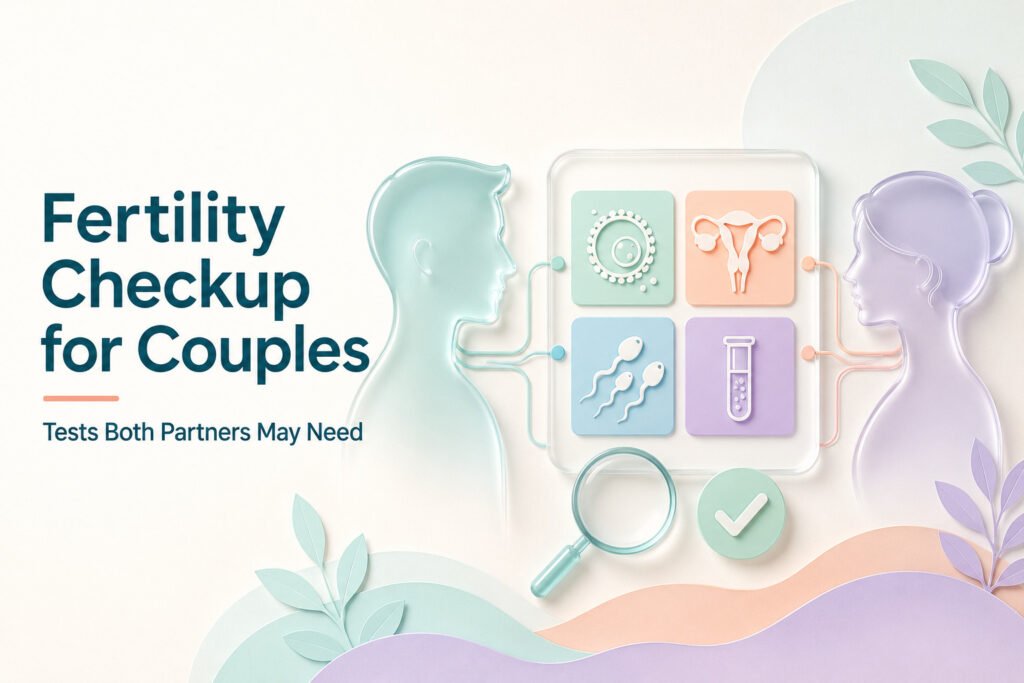
Table Of Content
- When May a Couple Need a Fertility Checkup?
- Why Should Both Partners Be Tested?
- Fertility Tests for the Female Partner
- Fertility Tests for the Male Partner
- Fertility Checkup for Couples: Tests at a Glance
- Is Preconception Fertility Testing the Same as an Infertility Workup?
- What Happens After Couple Fertility Tests?
- Does a Fertility Checkup Mean You Will Need IVF?
