




After egg retrieval, your IVF report may show terms such as MII, MI and GV beside the number of eggs collected. These letters describe different stages of egg maturity.
When discussing mature eggs after egg retrieval, MII is generally the stage the embryology team is looking for because an MII egg has completed the first meiotic division and is at the mature stage normally suitable for ICSI. MI and GV eggs are still immature at the time they are assessed.
This also explains why the number of eggs retrieved and the number of mature eggs in your report may not be the same.
Why Are Eggs Checked for Maturity After Retrieval?
During ovarian stimulation, several follicles are encouraged to grow at the same time. Once the follicles reach an appropriate stage, a trigger injection is given to support final egg maturation before retrieval.
Even with carefully timed stimulation and triggering, however, not every egg collected will necessarily have reached the same developmental stage.
The laboratory may therefore identify eggs as:
- MII – Metaphase II
- MI – Metaphase I
- GV – Germinal Vesicle
These stages describe nuclear maturity—the stage the egg has reached during meiosis, the specialised cell division involved in producing eggs and sperm.
Understanding these terms can make an IVF laboratory report much easier to read.
MII Eggs in IVF: What Does MII Mean?
MII stands for Metaphase II.
This is considered the mature nuclear stage of an egg. At MII, the egg has completed its first meiotic division and has released the first polar body, a small structure that embryologists can use as a visible sign of nuclear maturity.
For patients undergoing ICSI, MII eggs are the eggs normally suitable for sperm injection.
So if your report says:
10 eggs retrieved – 8 MII
it means eight of the retrieved eggs were identified as mature at the time of assessment.
It does not mean that all eight will definitely fertilise or form embryos.
Egg maturity is only one step in the IVF process.
MI Eggs Meaning: Are They Mature?
MI stands for Metaphase I.
An MI egg has started the maturation process but has not yet reached Metaphase II.
Unlike an MII egg, an MI egg does not yet show the first polar body used to identify completion of the first meiotic division.
In simple terms:
MI = developing, but not fully mature at the time of assessment.
Some MI eggs may continue maturing in laboratory culture and later reach the MII stage. Whether such an egg is used depends on the fertility laboratory’s protocols, timing and individual clinical situation.
Studies have shown that immature eggs can sometimes mature in vitro, but their developmental potential should not automatically be considered identical to eggs that were already mature at retrieval.
This is why an MI result should not be interpreted as either a guaranteed loss or a guaranteed usable egg.
GV Eggs in IVF: What Is the Germinal Vesicle Stage?
GV stands for Germinal Vesicle.
This is an earlier immature stage.
At the GV stage, the egg’s nucleus-called the germinal vesicle-is still visible. The egg has not yet progressed through the later stages of meiosis needed to reach MII maturity.
A simple way to understand the sequence is:
GV → MI → MII
The egg moves through these stages as it matures.
A GV egg is therefore less mature at the time of retrieval than an MI egg, while MII represents the mature stage normally required for ICSI.
MII vs MI vs GV: Quick Comparison
IVF Report Term | Full Form | Maturity Stage | What It Generally Means |
GV | Germinal Vesicle | Immature | Egg is still at an earlier stage of maturation |
MI | Metaphase I | Immature/intermediate | Egg has progressed further but has not yet reached MII |
MII | Metaphase II | Mature | Egg has reached the stage normally suitable for ICSI |
This classification describes egg maturity, not egg quality or future pregnancy potential.
An MII egg is mature, but maturity alone cannot tell whether it will fertilise normally or develop into a suitable embryo.
Why Aren't All Retrieved Eggs MII?
It is common for eggs from the same retrieval to be at different maturity stages.
Several factors can influence this, including:
- follicle-size differences
- timing of the trigger injection
- ovarian response to stimulation
- timing of egg retrieval
- individual biological variation
- stimulation protocol
Follicles within the same ovary do not always grow at exactly the same speed. A cycle may contain larger leading follicles alongside medium and smaller follicles, so the eggs collected from them may also be at different developmental stages.
This is one reason fertility specialists monitor the whole follicular group when deciding when to trigger final maturation.
What Is a Good Mature Egg Percentage?
Patients often calculate their mature egg percentage immediately after receiving the embryology report.
For example:
If 10 eggs were retrieved and 8 were MII:
8 ÷ 10 × 100 = 80% mature eggs
The calculation is simple. Interpreting it is not.
There is no single mature egg percentage that should be used as a pass/fail benchmark for every IVF cycle.
Research populations often report that most retrieved eggs after conventional ovarian stimulation are MII, but the proportions of MII, MI and GV eggs vary between studies, patients and treatment protocols.
Your own result should therefore be interpreted alongside:
- number of follicles before retrieval
- follicle sizes
- trigger timing
- total eggs retrieved
- previous IVF response
- age and ovarian reserve
- subsequent fertilisation results
A percentage alone cannot tell you whether the IVF cycle will result in pregnancy.
Does More MII Eggs Mean Better IVF Success?
Having more mature eggs provides more opportunities for fertilisation, but the relationship is not as simple as:
More MII eggs = guaranteed better outcome.
After maturity assessment, several further steps still have to occur:
MII eggs
→ fertilisation
→ embryo development
→ blastocyst formation where applicable
→ embryo transfer or freezing
Not every mature egg fertilises, and not every fertilised egg develops into a blastocyst.
Likewise, an embryo reaching the blastocyst stage does not guarantee implantation or pregnancy.
The mature egg number is useful information, but it is one part of the complete IVF laboratory picture.
Can MI or GV Eggs Become Mature Later?
Sometimes.
Immature MI or GV eggs may continue maturing during laboratory culture. This is sometimes described as rescue in-vitro maturation, or rescue IVM.
Research confirms that some immature oocytes can progress to the MII stage in vitro. However, their developmental competence may differ from eggs that matured within the body before retrieval, and laboratory practices vary.
Patients should therefore avoid assuming that every MI or GV egg will later become usable.
Your embryologist can explain whether immature eggs were cultured further and whether any reached MII in your particular cycle.
Does MII Mean the Egg Is Good Quality?
No. Maturity and quality are related concepts, but they are not the same thing.
MII tells the embryologist that the egg has reached a particular stage of nuclear maturation.
It does not confirm:
- normal chromosomes
- successful fertilisation
- normal embryo development
- blastocyst formation
- implantation
- pregnancy
An egg must undergo both nuclear and cytoplasmic maturation to support fertilisation and early development, and laboratory appearance cannot predict every aspect of developmental competence.
So seeing “MII” on your report is an important step, but it is not a final outcome.
How to Read Your Egg Retrieval Report Without Comparing Cycles
Consider this hypothetical report:
Eggs retrieved: 12
MII: 9
MI: 2
GV: 1
The useful interpretation is:
- 12 eggs were collected
- 9 were mature when assessed
- 2 were at the MI stage
- 1 was at the GV stage
What you cannot conclude from these numbers alone is how many embryos will develop or whether pregnancy will occur.
Comparing this result with someone who had 15 or 20 retrieved eggs can also be misleading. Age, ovarian response, sperm factors, stimulation protocol and embryo development may all be different.
When Should You Consult Your Fertility Doctor or Embryologist?
Ask your fertility team to explain your report if:
- the mature egg number was much lower than you expected
- several eggs were reported as MI or GV
- you have had low egg maturity in more than one IVF cycle
- you want to understand whether trigger timing may have influenced the result
- you are unsure how many eggs were suitable for IVF or ICSI
A lower MII number does not provide enough information to diagnose a problem by itself.
If you are also recovering from egg retrieval, seek medical advice for severe or worsening abdominal pain, heavy bleeding, persistent vomiting, difficulty breathing or markedly reduced urination rather than treating these as normal laboratory-related symptoms.
Final Thoughts
Understanding mature eggs after egg retrieval becomes much easier once MII, MI and GV are seen as stages rather than scores.
GV is an earlier immature stage, MI is an intermediate immature stage, and MII is the mature stage normally suitable for ICSI.
The MII count matters, but it should not be viewed in isolation. Fertilisation and embryo development provide the next pieces of information about the cycle.
Ova Fertility & Women Care provides egg retrieval, laboratory fertilisation, IVF and ICSI as part of its fertility services. If you are planning treatment or want to understand the stages involved, you can learn more about IVF treatment in Thane.
FAQ
1. What does MII mean in an IVF report?
MII means Metaphase II. It is the mature nuclear stage of the egg and is identified by features including extrusion of the first polar body. MII eggs are the eggs normally suitable for ICSI.
2. What does MI eggs mean after retrieval?
MI means Metaphase I. These eggs are still immature because they have not completed the first meiotic division or reached MII when assessed. Some MI eggs may continue maturing in laboratory culture.
3. Are GV eggs useless in IVF?
Not necessarily, but GV eggs are immature at retrieval. Some may mature in vitro, although this does not happen in every case and their developmental potential may differ from eggs that were already MII.
4. What mature egg percentage is considered normal?
There is no universal percentage that determines whether an IVF cycle is normal or successful. Maturity rates vary according to the patient, stimulation response, trigger timing and laboratory findings. Your fertility specialist should interpret the percentage in the context of your complete cycle.
5. Can an MII egg still fail to fertilise?
Yes. MII means the egg has reached the mature stage required for fertilisation, but it does not guarantee that fertilisation will occur. Fertilisation and subsequent embryo development are separate biological stages.
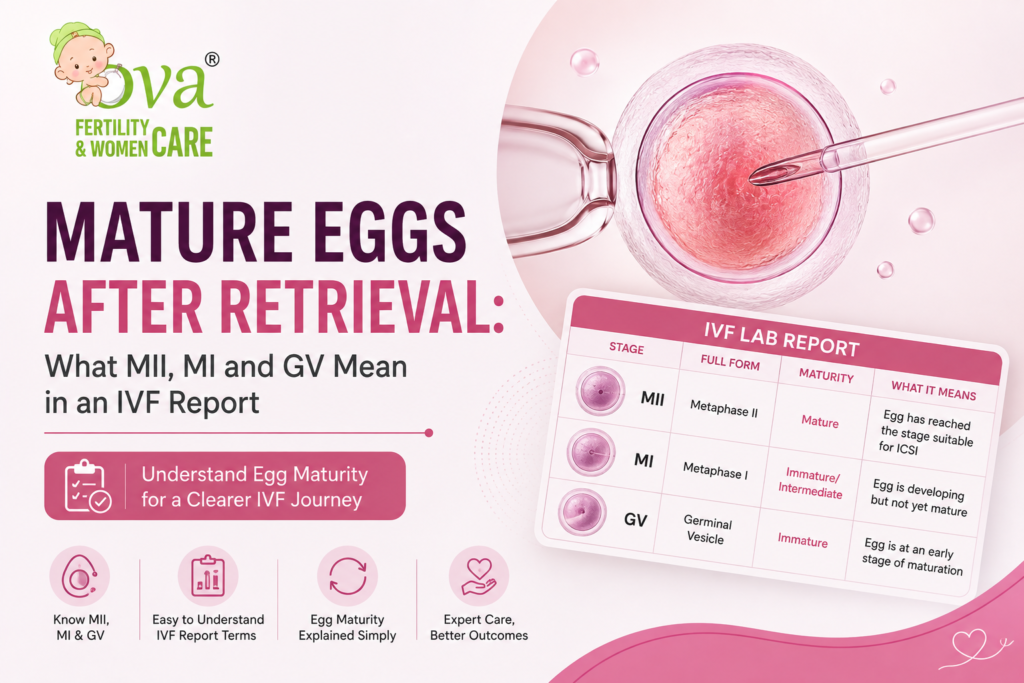
Table Of Content
- Why Are Eggs Checked for Maturity After Retrieval?
- MII Eggs in IVF: What Does MII Mean?
- MI Eggs Meaning: Are They Mature?
- GV Eggs in IVF: What Is the Germinal Vesicle Stage?
- MII vs MI vs GV: Quick Comparison
- Why Aren't All Retrieved Eggs MII?
- What Is a Good Mature Egg Percentage?
- Does More MII Eggs Mean Better IVF Success?
- Can MI or GV Eggs Become Mature Later?
- Does MII Mean the Egg Is Good Quality?
- How to Read Your Egg Retrieval Report Without Comparing Cycles
- When Should You Consult Your Fertility Doctor or Embryologist?
- Final Thoughts
- FAQ
