




An IVF fertilization rate tells you how many eggs fertilised normally after conventional IVF or ICSI. It is usually more useful to compare fertilised eggs with the eggs that were mature and suitable for fertilisation—not simply with the total number retrieved.
ASRM patient information notes that, broadly, around 70% of mature eggs fertilise during IVF treatment. This is a population-level estimate, not a target every cycle must meet.
For example, if 12 eggs are retrieved, it would be incorrect to automatically expect eight or nine embryos. Some eggs may be immature, some mature eggs may not fertilise, and some fertilised eggs may stop developing later.
The numbers naturally become smaller as IVF progresses.
Retrieved Eggs and Fertilised Eggs Are Not the Same Number
After egg retrieval, the laboratory first assesses the eggs.
The basic pathway is:
Eggs retrieved
↓
Mature eggs
↓
Eggs inseminated or injected
↓
Normally fertilised eggs
↓
Developing embryos
↓
Blastocysts where applicable
This distinction matters when patients ask, “If I got 10 eggs, how many should fertilise?”
The answer depends first on how many of those 10 eggs are mature.
For ICSI, the mature MII eggs are generally the ones injected with sperm. With conventional IVF, eggs are placed with prepared sperm and fertilisation is assessed later.
So your fertilization percentage should not automatically be calculated from the total egg-retrieval number.
What Does IVF Fertilization Rate Actually Mean?
In simple terms, the fertilization rate describes the proportion of suitable eggs that show normal evidence of fertilisation after exposure to sperm or ICSI.
A simplified example:
- 10 eggs retrieved
- 8 are mature and suitable for ICSI
- 6 show normal fertilisation
The fertilization rate among the injected mature eggs would be:
6 ÷ 8 × 100 = 75%
It would not usually be helpful to describe this simply as 6 out of 10 without mentioning that two retrieved eggs were immature.
Laboratories may report and calculate their figures slightly differently, so ask your embryologist what denominator has been used in your IVF fertilization report.
What Are 2PN Embryos?
One of the most common terms you may see after fertilisation is 2PN.
PN means pronucleus.
After normal fertilisation, the embryologist usually expects to see two pronuclei:
- one representing maternal genetic material
- one representing paternal genetic material
ESHRE’s updated IVF laboratory guidance recommends examining inseminated or injected oocytes for pronuclei and polar bodies around 16–18 hours after insemination. An egg showing two pronuclei is considered normally fertilised at this stage.
So if your laboratory update says:
6 × 2PN
it generally means six eggs showed normal fertilisation when assessed.
Patients often call them 2PN embryos, although at this very early stage the laboratory is specifically documenting the fertilisation status before further embryo development is assessed.
What If the Report Shows 0PN, 1PN or 3PN?
Not every fertilisation check shows the expected two pronuclei.
You may occasionally see terms such as:
- 0PN – no pronuclei seen at the assessment time
- 1PN – one pronucleus seen
- 2PN – two pronuclei, the usual sign of normal fertilisation
- 3PN or more – an abnormal pronuclear pattern
The interpretation is not always as simple as the number alone because the timing of observation matters.
For example, pronuclei may occasionally appear or disappear outside the observation window. Your embryologist should therefore interpret unusual findings rather than the patient trying to predict embryo potential from the report.
ESHRE recommends against transferring or cryopreserving embryos derived from oocytes showing three or more pronuclei.
How Many Mature Eggs Usually Fertilize?
ASRM patient education gives a broad estimate that around 70% of mature eggs fertilise during IVF.
Think of this as an educational average rather than a minimum acceptable score.
A particular cycle may have:
- a higher fertilization rate
- a lower fertilization rate
- complete fertilization failure in uncommon situations
The result can be influenced by several factors, including:
- egg maturity
- sperm quality
- method of fertilisation
- previous fertilisation history
- individual egg and sperm biology
- laboratory observations
This is why one percentage cannot predict the final number of embryos.
Conventional IVF vs ICSI: Does Fertilization Rate Differ?
Conventional IVF and ICSI use different methods to bring the egg and sperm together.
Conventional IVF
Prepared sperm are placed with the eggs in the laboratory, allowing fertilisation to occur without direct injection into the egg.
ICSI
A single sperm is injected directly into the cytoplasm of a mature egg.
ICSI is commonly used for certain male-factor fertility problems and in other selected clinical situations.
But ICSI does not automatically mean every mature egg will fertilise.
Current ASRM guidance states that routine ICSI for all patients without male-factor infertility or previous fertilization failure has not been shown to improve live-birth rates compared with conventional IVF.
So a higher technical intervention should not be interpreted as a guarantee of fertilisation or pregnancy.
Imagine your report says:
Eggs retrieved: 11
Mature MII eggs: 9
Normally fertilised: 7 (2PN)
The useful interpretation is:
- 11 eggs were collected
- 9 had reached the mature stage
- 7 showed normal fertilisation
The next question is not whether seven is “good” compared with another patient’s result.
The next question is:
How do those normally fertilised eggs develop over the following days?
Fertilisation is only one stage.
Does a Good Fertilization Rate Mean You Will Get Many Blastocysts?
Not necessarily.
ASRM explains that although many mature eggs fertilise, only some fertilised eggs continue developing to the blastocyst stage. It gives a broad educational estimate that roughly half of fertilised eggs may continue to blastocyst development.
Again, this is not a promise for an individual IVF cycle.
Embryo development can vary because of factors related to:
- egg competence
- sperm factors
- maternal age
- genetics
- individual embryo biology
A cycle with a high fertilization percentage can still have considerable embryo attrition.
A cycle with fewer fertilised eggs may still produce an embryo suitable for transfer or freezing.
What If Fewer Eggs Fertilize Than Expected?
A lower fertilization result can be upsetting, particularly after ovarian stimulation and egg retrieval.
It does not have one single cause.
The fertility specialist and embryologist may review:
- number of mature eggs
- sperm parameters
- whether conventional IVF or ICSI was used
- egg appearance and maturity
- previous fertilisation history
- laboratory findings
ASRM notes that ICSI may reduce the risk of another low or failed fertilization event in patients who previously had unexpectedly poor or failed fertilisation with conventional insemination. It also notes that there is no universally established cutoff defining “low fertilization” for this purpose.
Treatment decisions should therefore be made from the complete cycle history rather than one percentage alone.
When Should You Consult Your Fertility Specialist?
Ask your fertility doctor or embryologist for clarification if:
- you are unsure how the fertilization rate was calculated
- several retrieved eggs were immature
- fewer eggs fertilised than expected
- no eggs fertilised
- you have had low fertilisation in more than one cycle
- you want to understand whether IVF or ICSI may be more appropriate in a future cycle
An abnormal or lower-than-expected fertilization report needs clinical interpretation; it should not be self-diagnosed from online averages.
Final Thoughts
An IVF fertilization rate makes more sense when you look beyond the total number of eggs retrieved.
The more useful sequence is:
Retrieved eggs → mature eggs → normally fertilised 2PN eggs → developing embryos.
Around 70% of mature eggs may fertilise as a broad population estimate, but your result can be higher or lower without that percentage alone defining the outcome of your cycle.
Ova Fertility & Women Care provides IVF, ICSI and embryology services as part of its fertility treatment pathway, including care from a fertility specialist and senior embryology team. For patients planning or undergoing treatment, the clinic’s IVF treatment in Thane page explains the wider IVF process and available fertility services.
FAQ
1. What is a good IVF fertilization rate?
There is no universal percentage that defines a successful cycle. ASRM gives a broad estimate that around 70% of mature eggs fertilise, but individual results vary. Egg maturity, sperm factors and the method of fertilisation can all influence the result.
2. If 10 eggs are retrieved, how many usually fertilize?
You cannot accurately calculate this from 10 retrieved eggs alone because some may be immature. Fertilization is better considered in relation to the number of mature eggs that were actually inseminated or injected.
3. What does 2PN mean in an IVF fertilization report?
2PN means two pronuclei were seen during the fertilisation check. This is the usual laboratory sign of normal fertilisation. ESHRE recommends assessing pronuclei around 16–18 hours after insemination or injection.
4. Do all MII eggs fertilize after ICSI?
No. MII eggs are mature and generally suitable for ICSI, but injection of a sperm does not guarantee normal fertilisation. Some injected mature eggs may still fail to fertilise.
5. Does a high fertilization rate mean IVF will succeed?
No. Fertilisation is only one stage of IVF. Fertilised eggs still need to continue developing, and not every embryo reaches the blastocyst stage, implants or results in pregnancy.
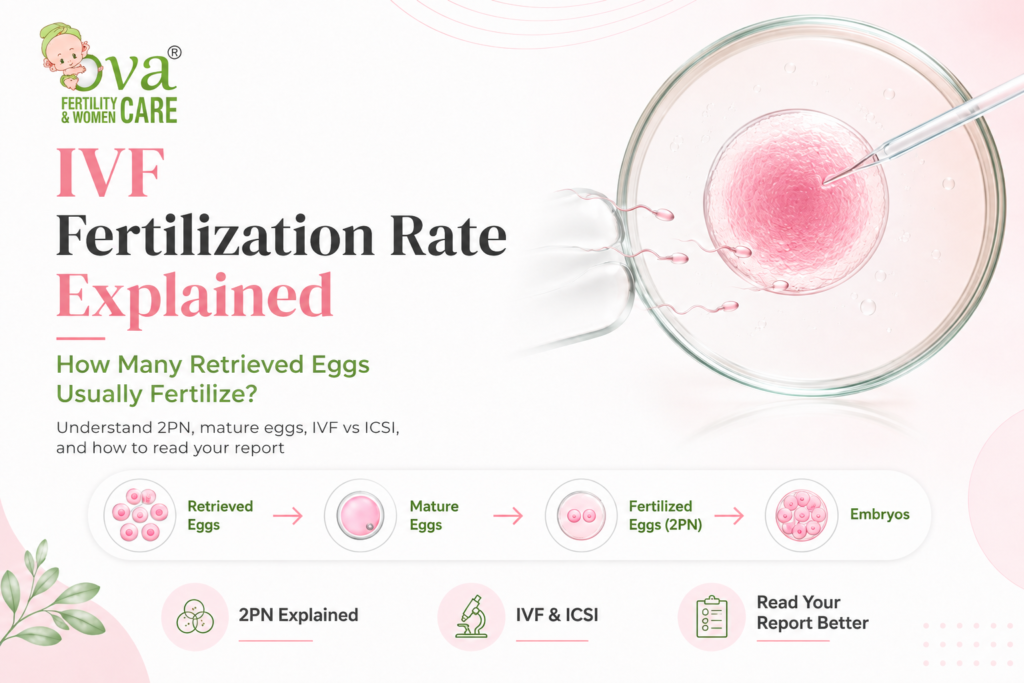
Table Of Content
- Retrieved Eggs and Fertilised Eggs Are Not the Same Number
- What Does IVF Fertilization Rate Actually Mean?
- What Are 2PN Embryos?
- What If the Report Shows 0PN, 1PN or 3PN?
- How Many Mature Eggs Usually Fertilize?
- Conventional IVF vs ICSI: Does Fertilization Rate Differ?
- How Should You Read an IVF Fertilization Report?
- Does a Good Fertilization Rate Mean You Will Get Many Blastocysts?
- What If Fewer Eggs Fertilize Than Expected?
- When Should You Consult Your Fertility Specialist?
- Final Thoughts
- FAQ
