




Finding fibroids on an ultrasound can immediately raise concerns about fertility. But having a fibroid does not automatically mean it is preventing pregnancy.
The relationship between fibroids and infertility depends strongly on where the fibroid is located, whether it changes the shape of the uterine cavity, its size and number, and whether other fertility factors are present.
Fibroids that grow into or distort the uterine cavity are generally more relevant to fertility than those growing on the outside of the uterus. ASRM notes that treatment may be considered for cavity-distorting fibroids, while surgery is generally not recommended solely to improve fertility for asymptomatic fibroids that do not distort the cavity.
This is why fertility treatment should not be based simply on the statement, “You have a fibroid.”
What Are Uterine Fibroids?
Fibroids, also called leiomyomas or myomas, are non-cancerous growths that develop from the muscular tissue of the uterus.
They may occur as a single fibroid or several fibroids of different sizes.
Some women have no symptoms. Others may experience:
- Heavy or prolonged periods
- Painful periods
- Pelvic pressure
- Lower abdominal discomfort
- Frequent urination
- Constipation
- Pain during intercourse
- Fertility or pregnancy concerns
ACOG notes that many fibroids cause no symptoms, while some may be associated with infertility or miscarriage.
Which Types of Fibroids Are Most Relevant to Fertility?
Doctors usually classify fibroids according to their location.
1. Submucosal Fibroids
Submucosal fibroids grow toward or into the uterine cavity.
These are generally the fibroids of greatest concern when fertility is being evaluated because they may change the shape of the cavity where an embryo needs to implant.
The connection between submucosal fibroid infertility may involve:
- Distortion of the uterine cavity
- Reduced space for implantation
- Changes in the local endometrial environment
- Possible interference with embryo implantation
ASRM reports fair evidence that hysteroscopic removal of submucosal fibroids that distort the cavity can improve clinical pregnancy rates.
2. Intramural Fibroids
Intramural fibroids grow within the muscular wall of the uterus.
Their fertility impact is less straightforward.
An intramural fibroid that becomes large enough to distort the uterine cavity may be more relevant than a small intramural fibroid that leaves the cavity unchanged.
Doctors therefore consider:
- Size
- Number
- Distance from the uterine cavity
- Whether the endometrial contour is distorted
- Symptoms
- Previous fertility treatment results
Evidence is less certain regarding removal of non-cavity-distorting intramural fibroids solely to improve fertility.
3. Subserosal Fibroids
Subserosal fibroids grow toward the outer surface of the uterus.
Because they generally do not affect the uterine cavity, they are usually less likely to interfere with implantation.
ASRM states that there is insufficient evidence that removing subserosal fibroids improves fertility.
However, very large fibroids may still cause pain, pressure or distortion of surrounding pelvic anatomy and may require treatment for other reasons.
Does Fibroid Size Matter?
Yes, but size should not be considered in isolation.
A small fibroid growing directly into the uterine cavity may be more relevant to fertility than a larger fibroid growing away from the cavity.
Doctors generally consider:
- Location
- Size
- Number
- Cavity distortion
- Symptoms
- Fertility history
There is no single fibroid size at which surgery becomes necessary for every fertility patient.
This is why a fertility-focused ultrasound assessment is more useful than simply reading the fibroid measurement from a scan report.
How Can Fibroids Affect Pregnancy?
The fibroids pregnancy relationship also varies according to fibroid location and size.
Many women with fibroids become pregnant and have healthy pregnancies.
However, certain fibroids may be associated with concerns such as:
- Difficulty with implantation
- Pregnancy loss
- Pain during pregnancy
- Changes in fetal position
- Other pregnancy complications depending on size and location
ACOG includes infertility and miscarriage among possible complications associated with fibroids, although most fibroids do not necessarily cause these problems.
A fibroid found during pregnancy is usually monitored according to symptoms and its location rather than automatically treated.
How Do Doctors Check Whether a Fibroid Is Affecting Fertility?
A routine fertility evaluation may include several methods.
Transvaginal Ultrasound
This is usually the first imaging test used to identify:
- Number of fibroids
- Their approximate size
- Their location
- Ovaries and other pelvic structures
Saline Sonography
Saline infusion sonography can provide a clearer view of the inside of the uterus.
It can help determine whether a fibroid projects into or distorts the uterine cavity.
Hysteroscopy
Hysteroscopy allows doctors to directly see the inside of the uterus.
It may be particularly useful for submucosal fibroids and may also allow treatment during the same procedure when appropriate.
MRI
MRI may occasionally be recommended when fibroids are numerous, large, difficult to map on ultrasound or when detailed surgical planning is needed.
Does Every Fibroid Need Treatment Before Trying for Pregnancy?
No.
This is one of the most important points in uterine fibroids fertility planning.
A fibroid may simply be monitored when:
- It does not distort the uterine cavity
- There are no significant symptoms
- Fertility testing suggests another cause of infertility
- Surgery is unlikely to improve the chance of conception
ASRM specifically advises that myomectomy is generally not recommended solely to improve pregnancy outcomes in asymptomatic infertile women with non-cavity-distorting fibroids.
The decision should balance potential benefits against surgical risks.
When May Fibroid Removal Be Considered for Fertility?
Fibroid treatment for fertility may be discussed when:
- A submucosal fibroid distorts the cavity
- An intramural fibroid significantly alters the uterine cavity
- Fibroids cause heavy bleeding or significant pain
- Pelvic anatomy is severely distorted
- A fibroid may interfere with fertility procedures
- Previous treatment history suggests the fibroid may be clinically relevant
The type of procedure depends on fibroid location.
Hysteroscopic Myomectomy
Usually considered for fibroids growing into the uterine cavity.
The procedure is performed through the cervix without abdominal incisions.
Laparoscopic Myomectomy
May be considered for selected fibroids within or on the outer part of the uterus.
Ova Fertility & Women Care explains that laparoscopic fibroid removal may be suitable depending on the number, size and location of fibroids, with reproductive goals considered during surgical planning.
Patients who need fertility-preserving surgery can learn more about laparoscopic surgery for gynecological conditions and when minimally invasive surgery may be appropriate.
Open Myomectomy
For very large, numerous or technically difficult fibroids, an open surgical approach may sometimes be safer or more appropriate.
The surgical route should be selected according to the individual case rather than assuming laparoscopy is always possible.
Can Fibroids Affect IVF?
Fibroids may become relevant during IVF when they distort the uterine cavity or significantly change pelvic anatomy.
Before embryo transfer, doctors may review:
- Fibroid location
- Uterine cavity shape
- Endometrial appearance
- Previous implantation history
- Access to the ovaries for egg retrieval
A cavity-distorting fibroid may prompt discussion about treatment before embryo transfer.
On the other hand, removing a non-cavity-distorting fibroid simply because IVF is planned may not provide a proven benefit.
ASRM notes that myomectomy does not appear to impair reproductive outcomes after assisted reproductive treatment, but the benefit of removing many non-cavity-distorting fibroids remains uncertain.
What Should Be Checked Before Blaming Fibroids for Infertility?
Fibroids may be visible on ultrasound, but that does not mean they are necessarily the reason pregnancy has not occurred.
A proper fertility evaluation should also consider:
- Ovulation
- Age and ovarian reserve
- Fallopian tube patency
- Sperm count and quality
- Endometriosis
- Other uterine conditions
- Duration of infertility
ACOG similarly advises that other possible causes should be explored before assuming fibroids are responsible for infertility.
When Should You Consult a Fertility Specialist?
The relationship between fibroids and infertility depends much more on fibroid location and uterine cavity distortion than simply on whether a fibroid is present.
Submucosal and cavity-distorting fibroids deserve closer attention during fertility planning, while many non-cavity-distorting fibroids may not require surgery.
The best approach is to evaluate the fibroid alongside age, ovarian reserve, tubes, sperm health and the couple’s overall fertility history.
If you have uterine fibroids and are planning pregnancy, the gynecology and fertility team at Ova Fertility & Women Care can review your imaging, symptoms and reproductive goals and help determine whether monitoring, fertility treatment or fibroid removal may be appropriate.
Final Thoughts
The relationship between endometriosis and fertility differs from one woman to another. Some may conceive naturally, while others may benefit from surgery, IUI, IVF or a combination of carefully selected treatments.
The key is to avoid treating endometriosis in isolation. Age, ovarian reserve, fallopian tube health, sperm results, previous surgery and fertility goals should all influence the decision.
If endometriosis is affecting your pregnancy plans, the fertility team at Ova Fertility & Women Care can review your symptoms, fertility reports and reproductive history and help determine whether natural attempts, surgical evaluation, IUI or IVF may be appropriate.
FAQ
1. Which fibroids are most likely to affect fertility?
Submucosal fibroids and intramural fibroids that distort the uterine cavity are generally considered more relevant to fertility. Subserosal fibroids growing away from the cavity are less clearly associated with infertility.
2. Can I get pregnant naturally with fibroids?
Yes. Many women with fibroids conceive naturally. The likelihood depends on fibroid location, cavity distortion, age, ovarian reserve, fallopian tube health, sperm factors and other fertility conditions.
3. Should a submucosal fibroid be removed before pregnancy?
Removal may be considered when a submucosal fibroid distorts the uterine cavity, particularly in women experiencing infertility. Hysteroscopic myomectomy has evidence supporting improved clinical pregnancy rates in this situation.
4. Does every intramural fibroid need surgery before IVF?
No. The benefit of removing non-cavity-distorting intramural fibroids solely to improve fertility remains uncertain. Doctors consider size, location, symptoms, cavity distortion and previous IVF history before recommending surgery.
5. Can laparoscopic surgery preserve fertility when removing fibroids?
In selected cases, laparoscopic myomectomy allows fibroids to be removed while preserving the uterus. Whether it is suitable depends on fibroid size, number and location, as well as previous surgery and reproductive goals.
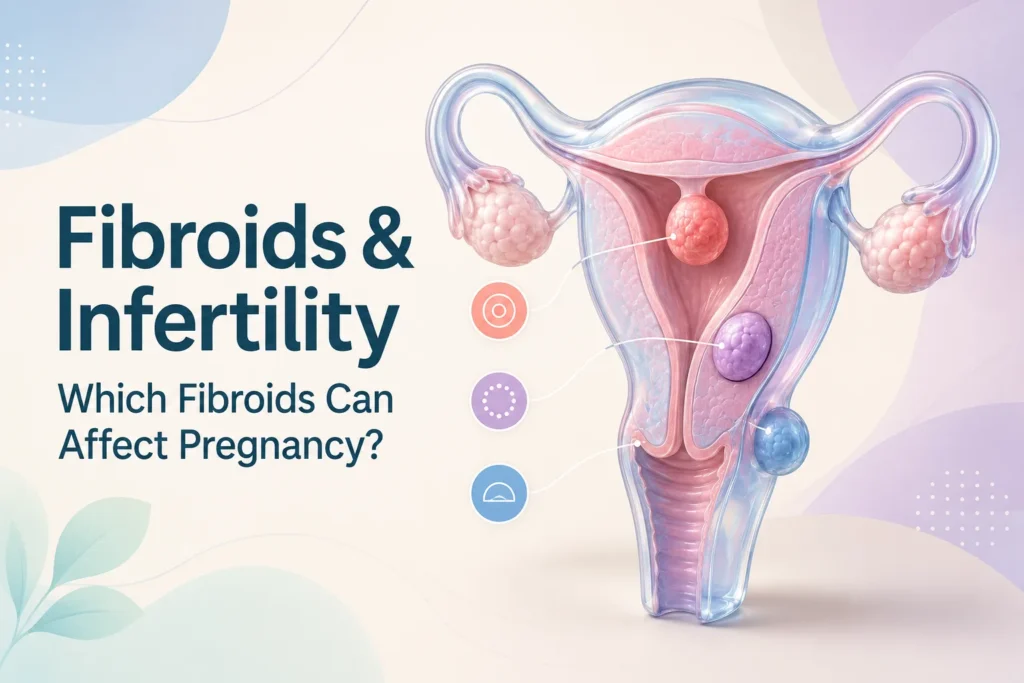
Table Of Content
- What Are Uterine Fibroids?
- Which Types of Fibroids Are Most Relevant to Fertility?
- Does Fibroid Size Matter?
- How Can Fibroids Affect Pregnancy?
- How Do Doctors Check Whether a Fibroid Is Affecting Fertility?
- Does Every Fibroid Need Treatment Before Trying for Pregnancy?
- When May Fibroid Removal Be Considered for Fertility?
- Can Fibroids Affect IVF?
- What Should Be Checked Before Blaming Fibroids for Infertility?
