




PCOS is a common reason for irregular or absent ovulation, which can make pregnancy more difficult to time. However, needing fertility help with PCOS does not automatically mean IVF is the first treatment.
A PCOS fertility treatment plan usually begins by understanding whether ovulation is occurring, checking other fertility factors, and choosing the least intensive treatment that reasonably fits the situation. For many women whose main fertility issue is anovulation from PCOS, treatment may start with ovulation induction and carefully timed intercourse before IUI or IVF is considered.
Age, fallopian tube health, sperm results, ovarian reserve, previous treatment and other fertility conditions can all change this pathway.
Why Can PCOS Make It Difficult to Conceive?
PCOS, or polycystic ovary syndrome, can interfere with the hormonal signals needed for regular follicle development and ovulation.
Some women with PCOS:
- Ovulate irregularly
- Have long menstrual cycles
- Skip periods
- Develop follicles that do not consistently release an egg
If ovulation does not happen regularly, there are fewer predictable opportunities for sperm and egg to meet.
This is why PCOS infertility treatment often focuses first on restoring or inducing ovulation rather than immediately moving to IVF.
However, PCOS is not the only possible fertility factor. A woman can have PCOS along with blocked tubes, endometriosis, age-related fertility changes or a male fertility factor. Those issues need to be considered before treatment is chosen.
First Step: Check Whether PCOS Is the Main Fertility Problem
Before starting fertility medicines, doctors usually review both partners.
Evaluation may include:
For the Woman
- Menstrual and ovulation history
- Pelvic ultrasound
- Hormonal evaluation when required
- Ovarian reserve assessment
- Fallopian tube testing depending on history and planned treatment
For the Male Partner
A semen analysis may be advised to evaluate sperm concentration, movement and morphology.
The 2023 International Evidence-based PCOS Guideline recommends considering the risks, benefits and timing of tubal patency testing before ovulation induction with timed intercourse or IUI, based on the woman’s history and individual circumstances.
Ova Fertility & Women Care similarly bases female infertility treatment on diagnosis, age, ovulation, tubal factors and partner-related fertility findings rather than using the same treatment for everyone.
Step 1: Preconception Health and Cycle Planning
Before fertility medicines are started, doctors may review general health factors that could affect treatment or pregnancy.
This may include:
- Blood pressure
- Blood sugar or diabetes risk
- Current medicines
- Smoking and alcohol
- Nutrition
- Physical activity
- Sleep
- Weight-related health concerns where relevant
Lifestyle measures can support reproductive and metabolic health in PCOS, but they should not be presented as a guaranteed fertility treatment.
Women should also not delay fertility evaluation for months simply in an attempt to reach a particular weight before receiving medical advice. Age and other fertility factors still matter when deciding how quickly treatment should proceed.
Step 2: PCOS Ovulation Induction
When irregular or absent ovulation is the main fertility problem, doctors may recommend medication to help a follicle develop and release an egg.
This is called PCOS ovulation induction.
Letrozole
Current international guidance recommends letrozole as the first-line pharmacological treatment for ovulation induction in women with PCOS who have anovulatory infertility and no other infertility factors.
The medicine is generally taken for several days early in the menstrual cycle according to the prescribed protocol.
Doctors may then monitor:
- Follicle growth
- Number of developing follicles
- Endometrial lining
- Expected timing of ovulation
Letrozole should only be used under medical guidance, and its regulatory approval for ovulation induction varies by country.
Other Medicines
Depending on availability, response and individual circumstances, doctors may also discuss other ovulation-induction treatments such as clomiphene citrate.
Metformin may be useful in selected women with PCOS, particularly for metabolic features, and may have a role in fertility treatment in some circumstances. However, the international guideline considers letrozole the preferred first-line pharmacological fertility treatment for anovulatory PCOS when there are no other infertility factors.
Step 3: Timed Intercourse During Ovulation Induction
If:
- Ovulation can be induced successfully
- At least one fallopian tube is suitable
- Sperm findings are reassuring
- No major additional fertility factor is present
doctors may recommend timed intercourse around the expected ovulation period.
Follicular monitoring can help determine when the dominant follicle is developing and when intercourse is most appropriately timed.
For some couples, this may be enough before considering more advanced treatment.
How Many Ovulation-Induction Cycles Are Tried?
There is no single number that applies to every patient.
Doctors usually review:
- Whether ovulation occurred
- Follicular response
- Age
- How long the couple has been trying
- Semen findings
- Tubal status
- Previous treatment outcomes
If ovulation is repeatedly achieved but pregnancy does not occur, it may be reasonable to reassess whether another fertility factor is present or whether treatment should move forward.
Repeating the same treatment indefinitely without reviewing the situation is usually not helpful.
Step 4: When May PCOS IUI Be Considered?
PCOS IUI may be considered when ovulation induction with timed intercourse has not resulted in pregnancy or when another mild fertility factor makes insemination reasonable.
IUI involves placing washed and prepared sperm directly into the uterus close to the time of ovulation.
Before recommending IUI, doctors generally consider:
- Fallopian tube patency
- Sperm parameters
- Woman’s age
- Ovarian response
- Duration of infertility
Ova Fertility & Women Care lists hormonal imbalance, anovulation and PCOD among situations where IUI may be considered, provided tubal and sperm factors are suitable.
IUI is not automatically necessary just because someone has PCOS. If ovulation induction and well-timed intercourse are appropriate, those may be tried first.
What If Oral Ovulation Medicines Do Not Work?
Some women do not ovulate adequately with first-line oral treatment.
In selected cases, gonadotrophin injections may be considered as a second-line treatment.
These medicines stimulate follicle development but require closer ultrasound monitoring because multiple follicles can develop.
The international PCOS guideline recommends careful low-dose protocols when gonadotrophins are used, with attention to the risk of multiple pregnancy.
This treatment therefore needs specialist supervision.
When May IVF Be Considered for PCOS?
IVF does not need to be the first step for most women whose only fertility problem is anovulation from PCOS.
The 2023 international guideline states that IVF may be offered when first- or second-line ovulation-induction therapies have failed, in the absence of another reason that makes IVF necessary sooner.
IVF may also be considered earlier when there is another important fertility factor, such as:
- Significant bilateral tubal disease
- Severe male infertility
- Increasing reproductive age where time is important
- Other conditions affecting natural fertilisation
- Repeated failure of appropriate simpler treatments
During IVF, women with PCOS may sometimes respond strongly to ovarian stimulation, so treatment protocols are planned carefully to reduce the risk of ovarian hyperstimulation syndrome (OHSS).
Getting Pregnant With PCOS: Does Everyone Follow the Same Roadmap?
No.
Two women with PCOS can require completely different fertility plans.
For example:
Patient A: irregular ovulation, young age, open tubes and normal semen analysis may begin with ovulation induction.
Patient B: PCOS plus bilateral tubal blockage may need IVF because ovulation induction cannot correct blocked tubes.
Patient C: PCOS plus significant sperm abnormalities may require a treatment plan that addresses both partners.
This is why getting pregnant with PCOS should not be reduced to simply “take medicine first” or “do IVF.”
The complete fertility diagnosis matters.
When Should You Consult a Fertility Specialist?
Consider fertility evaluation if:
- Your periods are very irregular or absent.
- You have PCOS and are unsure whether you ovulate.
- Pregnancy has not occurred despite timed attempts.
- You have already tried ovulation medicines without success.
- You are 35 or older and do not want to delay evaluation.
- There may be a male or tubal fertility factor.
A structured female infertility treatment and fertility evaluation in Thane can help determine whether your next step should be cycle monitoring, ovulation induction, timed intercourse, IUI or IVF.
Ova Fertility & Women Care states that treatment for female infertility is chosen according to diagnosis, age, fertility goals and individual response, with less invasive options considered where appropriate.
Final Thoughts
A PCOS fertility treatment plan usually starts by identifying exactly what is preventing conception.
When irregular ovulation is the main issue, treatment may begin with ovulation induction and timed intercourse. IUI may be considered in selected situations, while IVF is usually reserved for cases where simpler treatments have not worked or another fertility factor makes IVF more appropriate.
The aim is not to move through treatments as quickly as possible. It is to choose the treatment that matches the actual fertility problem.
If you have PCOS and are trying to conceive, the fertility specialists at Ova Fertility & Women Care can evaluate ovulation, ovarian factors, fallopian tubes and partner-related fertility findings before recommending the next appropriate step.
FAQ
1. What is the first fertility treatment for PCOS?
If PCOS is causing anovulatory infertility and there are no other fertility factors, current international guidance recommends letrozole as the first-line pharmacological treatment for inducing ovulation. The exact treatment still depends on individual medical assessment.
2. Can I get pregnant with PCOS without IVF?
Yes. Many women with PCOS do not require IVF as their first fertility treatment. Depending on the fertility evaluation, ovulation induction with timed intercourse or IUI may be considered before IVF.
3. When is IUI used for PCOS infertility?
IUI may be considered when ovulation can be induced but pregnancy has not occurred with timed intercourse, or when another mild fertility factor makes insemination appropriate. Doctors generally review tubal patency and semen parameters before recommending IUI.
4. What happens if ovulation medicines do not work for PCOS?
Doctors may review the diagnosis, dose, ovarian response and other fertility factors. Selected patients may move to gonadotrophin treatment or another appropriate approach. IVF may be discussed if suitable ovulation-induction treatments fail or another indication for IVF is present.
5. Does PCOS mean I will eventually need IVF?
No. PCOS does not automatically mean IVF will be required. Treatment depends on whether ovulation can be restored, age, fallopian tube health, sperm results and response to earlier treatment.
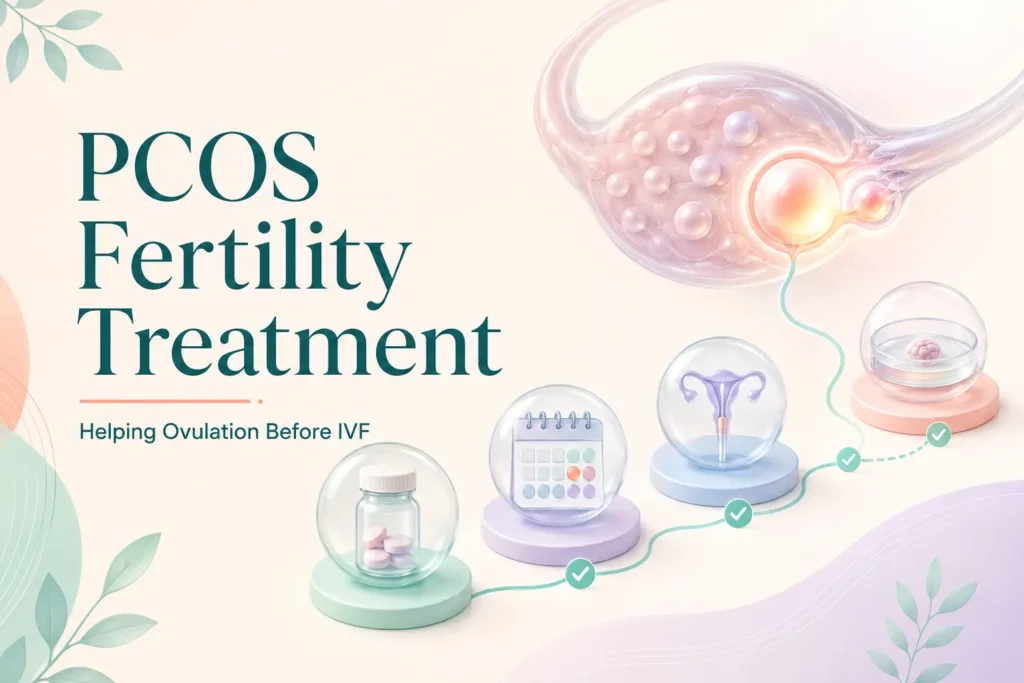
Table Of Content
