




When pregnancy does not happen as expected, it is common to wonder whether the next step should be medicines, IUI or IVF. The answer is not the same for every couple.
The right infertility treatment options depend on what fertility testing shows. Age, ovulation, ovarian reserve, fallopian tube health, sperm parameters, duration of infertility and previous treatment attempts can all influence the decision.
Importantly, fertility treatment is not always a fixed ladder where every patient must try medicines first, then IUI and finally IVF. Some couples may need only ovulation support. Others may be suitable for IUI. In situations such as significant tubal blockage or severe male-factor infertility, moving directly to IVF or IVF with ICSI may make more sense.
A good fertility treatment roadmap begins with understanding the cause before choosing the treatment.
Step 1: Fertility Evaluation Comes Before Treatment
Before deciding on treatment, doctors usually assess both partners.
A standard infertility evaluation may include:
For the Female Partner
- Menstrual and pregnancy history
- Ovulation assessment
- Pelvic or transvaginal ultrasound
- Ovarian reserve testing such as AMH or antral follicle count when appropriate
- Fallopian tube assessment
- Uterine evaluation
- Selected hormone tests
For the Male Partner
- Medical and reproductive history
- Semen analysis
- Additional hormone, ultrasound or specialist testing when indicated
ASRM recommends a systematic fertility evaluation that looks at ovulation, reproductive tract structure and tubal patency, along with semen evaluation of the male partner.
Ova Fertility & Women Care follows a similar approach, reviewing both partners before deciding whether natural conception planning, ovulation support or assisted reproductive treatment is appropriate.
Step 2: Can the Underlying Problem Be Treated First?
Not everyone needs IUI or IVF immediately.
Sometimes, fertility testing identifies a specific problem that can be managed first.
Examples may include:
- Thyroid imbalance
- High prolactin
- Irregular ovulation
- Certain uterine polyps or fibroids
- Infection when clinically relevant
- Selected male fertility conditions
The next step depends on whether correcting the problem is likely to improve the chance of conception.
For example, someone with irregular ovulation due to PCOS may have a very different treatment plan from someone with both fallopian tubes blocked.
Step 3: Ovulation Induction and Timed Intercourse
Ovulation induction fertility treatment may be considered when the main problem is irregular or absent ovulation.
Medicines may be used to encourage development and release of an egg. Ultrasound monitoring may then help determine:
- Whether follicles are developing
- How many follicles are growing
- When ovulation is likely
- When intercourse should be timed
This approach may be considered in selected patients when:
- Ovulation is irregular
- Fallopian tubes are open
- Sperm parameters are suitable
- No other major fertility problem is identified
Ovulation medicines are not simply given to everyone who has infertility. If a woman already ovulates regularly, the reason for delayed pregnancy may lie elsewhere.
Step 4: When May IUI Be Recommended?
IUI, or intrauterine insemination, involves preparing a sperm sample and placing selected sperm directly into the uterus around the time of ovulation.
IUI may be considered in situations such as:
- Mild sperm-related problems
- Unexplained infertility
- Certain ovulation problems
- Selected cervical factors
- Some couples using donor sperm
Before IUI, doctors generally need to know that at least one fallopian tube is open because fertilisation still takes place within the reproductive tract.
Ova Fertility & Women Care notes that its IUI planning includes a baseline fertility workup and assessment of tubal and sperm factors before treatment is advised.
For selected couples with unexplained infertility, ASRM supports a limited course of ovarian stimulation with oral medicines combined with IUI before moving to IVF if treatment is unsuccessful.
IUI or IVF Decision: What Changes the Recommendation?
The IUI or IVF decision is based on more than which treatment is simpler or less expensive.
Factor | IUI May Be Considered | IVF May Be Considered Earlier |
Fallopian tubes | At least one suitable open tube | Significant bilateral tubal disease |
Sperm factors | Mild abnormalities | Severe male-factor infertility |
Ovulation | Can be monitored or induced | Other major factors also present |
Ovarian reserve | Reasonable for age and plan | Low reserve may make time more important |
Female age | Younger patients may have time for simpler treatment | Increasing age may favour faster escalation |
Unexplained infertility | Often reasonable first treatment | After unsuccessful IUI or when age/time matters |
Previous treatment | Limited previous attempts | Repeated unsuccessful simpler treatments |
This table is only a general guide. A fertility specialist still needs to interpret the complete clinical situation.
Step 5: When May IVF Be Recommended?
IVF involves stimulating the ovaries, retrieving eggs, fertilising them in the laboratory and transferring a selected embryo into the uterus.
Doctors may discuss IVF earlier when there is:
Blocked or Severely Damaged Fallopian Tubes
IVF can bypass the fallopian tubes because fertilisation happens in the laboratory.
Severe Male-Factor Infertility
When sperm count, movement or availability is significantly affected, IVF with ICSI may be considered.
Reduced Ovarian Reserve or Increasing Reproductive Age
Time can become an important factor when ovarian reserve is low or maternal age is increasing.
This does not mean IVF automatically works better for everyone. It means spending many months on treatments with a low chance of helping may not always be appropriate.
Moderate or Severe Endometriosis
The treatment decision depends on age, ovarian reserve, symptoms, pelvic anatomy and previous surgery or fertility attempts.
Repeated IUI Failure
When appropriate IUI cycles have not resulted in pregnancy, IVF may be discussed as the next step.
For unexplained infertility specifically, ASRM recommends moving to IVF after a limited course of ovarian stimulation with IUI has been unsuccessful rather than continuing increasingly intensive IUI stimulation.
Where Does ICSI Fit Into the Roadmap?
ICSI is not a separate fertility journey from IVF. It is a fertilisation method used within an IVF cycle.
During conventional IVF, eggs and sperm are placed together in the laboratory.
During ICSI, an embryologist injects a selected sperm directly into a mature egg.
ICSI may be considered when there is:
- Very low sperm count
- Poor sperm motility
- Surgically retrieved sperm
- Previous fertilisation failure
- Another specific fertilisation concern
Not every IVF cycle automatically requires ICSI.
Do You Have to Try IUI Before IVF?
No.
This is an important point in understanding infertility treatment steps.
Trying IUI before IVF may make sense when:
- Tubes are open
- Sperm parameters are adequate
- Age and ovarian reserve allow time
- The diagnosis makes IUI reasonable
But IUI may add unnecessary delay when there is:
- Bilateral tubal blockage
- Severe male infertility
- Certain advanced reproductive-age situations
- Very low ovarian reserve where time is important
- Previous failed treatment that already makes IVF more appropriate
Treatment should match the diagnosis rather than follow a fixed sequence.
How Age Changes the Fertility Treatment Roadmap
Age is one of the most important factors in fertility planning because both egg quantity and egg quality change over time.
ASRM recommends infertility evaluation after 12 months of trying in women under 35, after 6 months in women aged 35 or older, and notes that more immediate evaluation and treatment may be appropriate over age 40.
Age can also affect how long doctors recommend trying simpler treatments before considering IVF.
For example, several IUI attempts may be reasonable for one patient but may create unnecessary delay for another.
How Many Treatment Cycles Should Be Tried Before Moving On?
There is no universal number for every diagnosis.
Doctors may review:
- Response to medicines
- Number of mature follicles
- Semen results after preparation
- Whether ovulation occurred
- Previous IUI outcomes
- Age
- Ovarian reserve
- Emotional and financial considerations
If the treatment is not addressing the main fertility problem, repeating it indefinitely may not be useful.
The goal is to review results after each stage and decide whether continuing, adjusting or moving to another option makes sense.
Questions to Ask Before Choosing a Fertility Treatment
Before starting treatment, consider asking:
- What is the most likely cause of our infertility?
- Are both partners fully evaluated?
- Why are you recommending this treatment?
- Would IUI reasonably help in our situation?
- Is there any reason to consider IVF sooner?
- How many treatment attempts would you recommend before reviewing the plan?
- Would conventional IVF or ICSI be more appropriate if IVF is needed?
- Are there any problems that should be treated before fertility treatment begins?
A clear explanation of why a treatment has been recommended is just as important as understanding how the procedure works.
When Should You Consult a Fertility Specialist?
Consider fertility consultation if pregnancy has not occurred within the recommended time for your age, or earlier if there are known concerns involving ovulation, ovarian reserve, fallopian tubes, sperm health, endometriosis or previous fertility treatment.
A structured infertility evaluation and treatment in Thane can help identify the likely cause first and then determine whether natural conception planning, medicines, IUI, IVF or another approach is appropriate.
Ova Fertility & Women Care emphasises choosing the least invasive suitable treatment rather than automatically moving every patient to advanced procedures.
Final Thoughts
There is no single fertility treatment roadmap that works for every couple.
The right sequence begins with identifying the fertility factors involved. Some patients may benefit from medicines and ovulation monitoring, some from IUI, while others may have a clinical reason to consider IVF or ICSI sooner.
Understanding your diagnosis helps avoid both unnecessary treatment and unnecessary delay.
If you are comparing infertility treatment options, the fertility specialists at Ova Fertility & Women Care can review both partners’ test results and explain which treatment approach may be appropriate based on your individual fertility situation.
FAQ
1. What are the main infertility treatment options?
Infertility treatment options may include treating an underlying medical condition, ovulation induction, timed intercourse, IUI, IVF and IVF with ICSI. The appropriate option depends on age, ovulation, ovarian reserve, fallopian tubes, sperm factors and previous treatment history.
2. Should I try IUI before IVF?
Not always. IUI may be reasonable when at least one fallopian tube is open and sperm factors are suitable. IVF may be recommended sooner when there is significant tubal disease, severe male infertility or another factor that makes IUI unlikely to help.
3. What is ovulation induction in fertility treatment?
Ovulation induction uses medicines to support follicle development and ovulation. It is mainly useful when ovulation is irregular or absent and may be combined with timed intercourse or IUI depending on other fertility findings.
4. How do doctors decide when to move from IUI to IVF?
Doctors consider age, ovarian reserve, diagnosis, number of previous IUI attempts, sperm parameters and treatment response. For many couples with unexplained infertility, a limited course of stimulated IUI may be followed by IVF if pregnancy does not occur.
5. Does needing IVF mean simpler fertility treatments failed?
Not necessarily. Some conditions make IVF the more appropriate starting treatment. For example, significant bilateral tubal blockage may make IUI unsuitable because IUI still relies on the fallopian tubes for fertilisation.
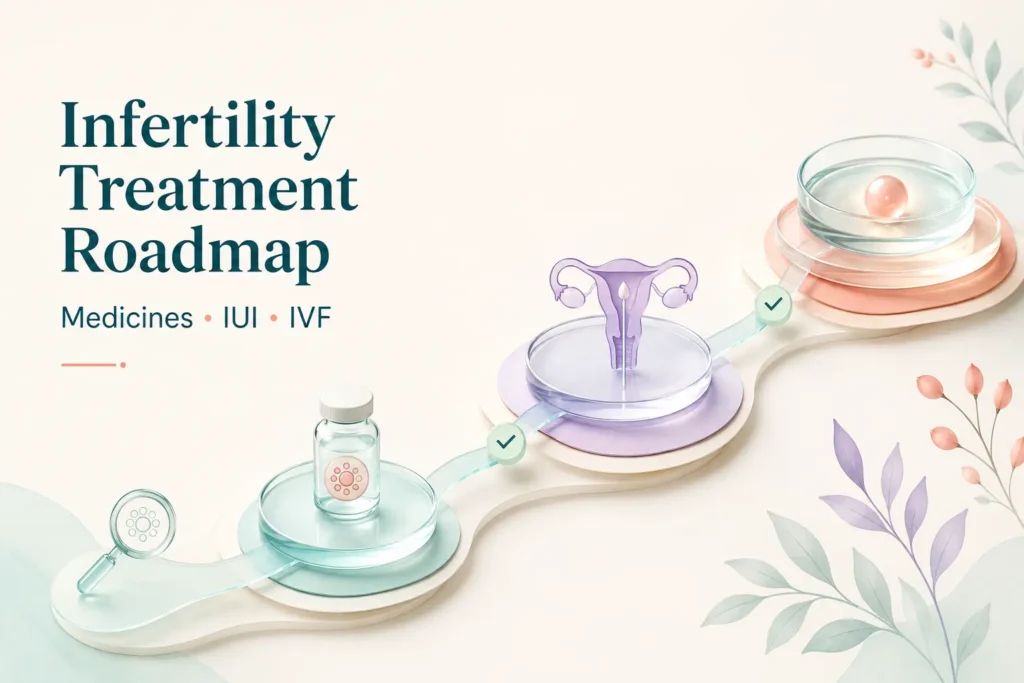
Table Of Content
- Infertility Treatment Roadmap: How Doctors Choose Between Medicines, IUI and IVF
- IUI or IVF Decision: What Changes the Recommendation?
- Step 5: When May IVF Be Recommended?
- Where Does ICSI Fit Into the Roadmap?
- Do You Have to Try IUI Before IVF?
- How Age Changes the Fertility Treatment Roadmap
- How Many Treatment Cycles Should Be Tried Before Moving On?
