




An IVF timeline day by day usually starts around the beginning of the menstrual cycle, followed by ovarian stimulation, follicle monitoring, a trigger injection, egg retrieval, fertilisation, embryo development and either embryo transfer or embryo freezing.
A commonly used IVF stimulation phase lasts around 8–14 days, although your actual schedule may be shorter or longer. Eggs are generally retrieved about 36 hours after the final trigger injection.
That means there is no single IVF calendar that every patient will follow.
Your age, ovarian reserve, response to medicines, type of IVF protocol, embryo development and whether you have a fresh or frozen embryo transfer can all change the timeline.
IVF Cycle Timeline at a Glance
A typical short IVF protocol may look like this:
Approximate Stage | What Usually Happens |
Period Day 1 | Menstrual cycle begins |
Days 2–3 | Baseline scan and treatment planning |
Days 2–5 onward | Ovarian stimulation medicines begin |
Days 5–10 | Follicle monitoring continues |
Around Days 8–14 | Final monitoring and trigger injection |
About 36 hours later | Egg retrieval |
Next day | Fertilisation is assessed |
Days 2–5 after retrieval | Embryos continue developing |
Around Days 3–5 | Fresh embryo transfer may be considered |
Later cycle | Frozen embryo transfer if planned |
After transfer | Pregnancy test on the date advised by the clinic |
This is only an example. Your fertility specialist may give you a different schedule.
Period Day 1: Informing Your Fertility Clinic
Day 1 usually means the first day of proper menstrual bleeding rather than light spotting.
Depending on your protocol, your fertility clinic may ask you to inform them when your period begins. This helps them plan your baseline scan and decide when fertility medicines should start.
Some IVF protocols also involve medicines before the period begins, so Day 1 is not the starting point for every patient.
Never start or change IVF medicines by following an online calendar. Use the dates and doses given by your fertility doctor.
Days 2–3: Baseline Scan
A baseline ultrasound is often carried out during the early days of the menstrual cycle.
The doctor may assess:
- the ovaries
- small resting follicles
- the uterine lining
- any ovarian cysts
- previous fertility investigations
Blood tests may also be advised depending on the treatment protocol.
If everything is suitable, ovarian stimulation can begin.
Days 2–14: Ovarian Stimulation
During IVF, medicines are used to encourage several ovarian follicles to develop at the same time.
This differs from a natural cycle, where usually one follicle becomes dominant.
The stimulation phase commonly lasts around 8–14 days.
During this part of the IVF process day by day, you may need injections every day.
Possible symptoms can include:
- mild bloating
- pelvic heaviness
- breast tenderness
- headache
- injection-site soreness
These symptoms do not tell you whether the treatment will succeed.
Follicle Monitoring During Stimulation
You will usually have ultrasound scans during stimulation.
These scans allow the fertility specialist to see how many follicles are developing and how large they are becoming.
The doctor may use the results to decide whether:
- your medicine dose should stay the same
- the dose needs adjustment
- more stimulation days are needed
- the follicles are ready for the trigger injection
Ova Fertility & Women Care includes ovarian stimulation and monitoring within its IVF treatment pathway.
Trigger Injection
When enough follicles have reached an appropriate stage, your doctor will schedule the final maturation or trigger injection.
Timing matters.
The trigger starts the final maturation process before egg collection. Egg retrieval is commonly planned about 36 hours after the trigger.
Take the trigger at the exact time your fertility team gives you.
Do not move the time forward or backward yourself.
Egg Retrieval Day
During egg retrieval, a fine needle is guided through the vaginal wall into the ovarian follicles using ultrasound.
The follicular fluid is collected and examined in the laboratory for eggs.
Not every follicle necessarily contains an egg, so the number of follicles seen on ultrasound and the number of eggs retrieved may be different.
Sedation is commonly used during the procedure.
Mild pelvic pain, spotting or tiredness may occur afterwards.
Day 1 After Egg Retrieval: Fertilisation Check
The laboratory assesses the retrieved eggs and identifies which are mature.
Fertilisation is then attempted using conventional IVF or ICSI depending on the treatment plan.
The following numbers may all be different:
Follicles → Eggs Retrieved → Mature Eggs → Fertilised Eggs → Embryos
A reduction at each stage can occur naturally.
Days 2–5: Embryo Development
Successfully fertilised eggs are monitored as they divide and develop.
Some embryos continue developing to the blastocyst stage around Day 5 or Day 6.
Depending on the cycle, the fertility team may:
- perform a fresh embryo transfer
- continue embryo culture
- freeze suitable embryos
- plan genetic testing where indicated
The decision depends on embryo development and the patient’s treatment plan.
Fresh Transfer vs Frozen Transfer
A fresh transfer happens within the same general treatment cycle as egg retrieval.
A frozen embryo transfer happens later using an embryo that has been cryopreserved.
A frozen transfer may be planned when:
- the doctor recommends a freeze-all approach
- the risk of OHSS is higher
- embryo testing is planned
- the endometrium is not suitable for transfer
- embryos are being stored for future use
This is why answering how long does IVF take is not always straightforward.
One patient’s IVF journey may take a few weeks, while another patient’s retrieval and embryo transfer may happen in separate cycles.
The Wait Before the Pregnancy Test
After embryo transfer, progesterone or other medicines may be continued as prescribed.
You may experience:
- mild cramping
- bloating
- breast tenderness
- tiredness
- light spotting
- no noticeable symptoms
None of these can reliably confirm whether implantation has happened.
Avoid using symptoms alone to decide whether IVF has worked.
Also avoid stopping prescribed medicines because of spotting unless your fertility specialist tells you to do so.
When Should You Consult a Doctor?
Contact your fertility team during an IVF cycle if you experience symptoms that are severe or getting worse, such as:
- severe abdominal pain
- rapidly increasing abdominal swelling
- persistent vomiting
- inability to keep fluids down
- significantly reduced urination
- difficulty breathing
- heavy vaginal bleeding
- fainting or severe weakness
Severe swelling, vomiting, breathing difficulty and reduced urination can occur with significant ovarian hyperstimulation syndrome and need medical assessment.
Final Thoughts
An IVF timeline day by day helps you understand the order of treatment, but your cycle does not need to match another patient’s calendar.
Scans, ovarian response, egg maturity and embryo development determine what happens next.
If you are preparing for IVF, Ova Fertility & Women Care offers assessment, IVF, ICSI and related fertility services. You can learn more about the clinic’s IVF treatment in Thane and discuss your expected treatment timeline with a fertility specialist.
FAQ
1. How long does an IVF cycle take?
The ovarian stimulation part commonly lasts around 8–14 days, but the complete timeline can be several weeks. Frozen embryo transfer, additional testing or a different stimulation protocol can make the overall IVF cycle timeline longer.
2. On which day of the period does IVF start?
Many short protocols begin during the first few days of the menstrual cycle. Some protocols start medication earlier, so the correct starting day should come from your fertility specialist.
3. How many days after the trigger is egg retrieval done?
Egg retrieval is usually performed about 36 hours after the trigger injection. The exact timing is planned by the fertility clinic and should be followed carefully.
4. Is embryo transfer always done on Day 5?
No. Transfer timing depends on embryo development and the treatment plan. In some cases, embryos are frozen instead of being transferred during the retrieval cycle.
5. Can symptoms after embryo transfer tell if IVF worked?
No. Cramping, breast tenderness, bloating or even having no symptoms cannot confirm pregnancy. The pregnancy test performed on the date advised by your clinic is more reliable.
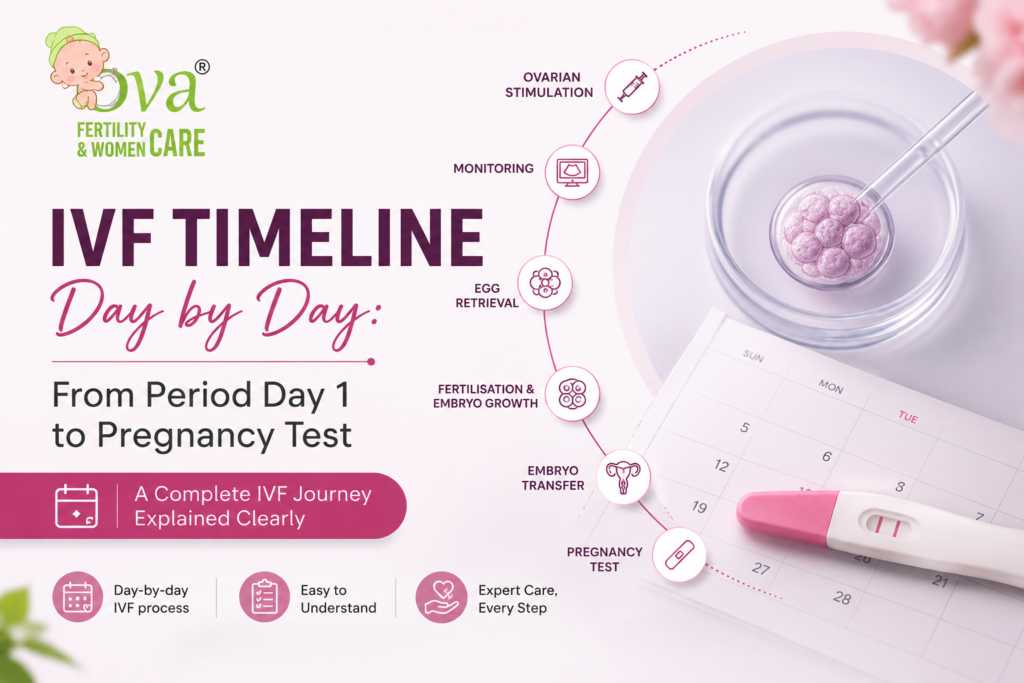
Table Of Content
- IVF Cycle Timeline at a Glance
- What Is Oncofertility?
- Days 2–3: Baseline Scan
- Days 2–14: Ovarian Stimulation
- Follicle Monitoring During Stimulation
- Trigger Injection
- Egg Retrieval Day
- Day 1 After Egg Retrieval: Fertilisation Check
- Days 2–5: Embryo Development
- Fresh Transfer vs Frozen Transfer
- The Wait Before the Pregnancy Test
- When Should You Consult a Doctor?
- Final Thoughts
- FAQ
